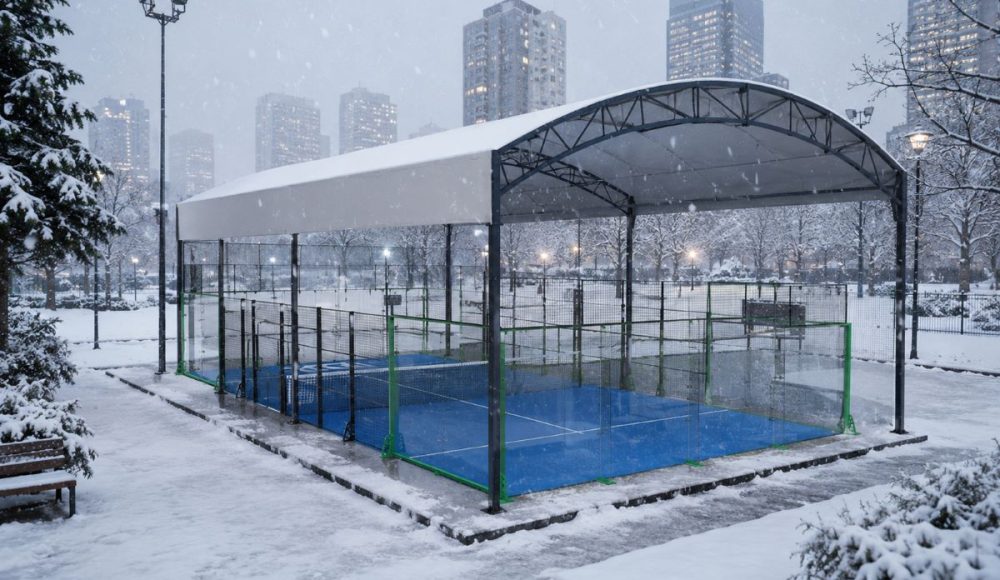
Sports facility developers, commercial club owners, and structural engineers in alpine regions face distinct environmental hazards when building outdoor athletic arenas. Unlike indoor fitness clubs, outdoor courts must withstand severe winter weather conditions year after year. Specifically, excessive winter storms can accumulate massive layers of dense, frozen snow on top of court glass and overhead canopies. If a builder installs standard structural frames in a cold northern climate, the excessive physical weight can deform the metal pillars, pull out base anchors, and cause a sudden, catastrophic structural failure.
Therefore, specifying a high-strength heavy snow load padel court frame architecture is an absolute necessity to guarantee long-term public safety and protect your commercial investment. This technical sourcing guide details the high-strength steel grades, specific metal wall thicknesses, and strict anti-corrosion standards required to survive demanding alpine environments.
1. Structural Steel Specifications and Geometric Reinforcements
To counteract high winds and heavy alpine winter loads, engineers must move away from standard thin-walled commercial metal tubes. Instead, you must specify heavy industrial structural steel profiles that handle extreme physical stress without bending.
 Standard Mild Steel (2mm): [Heavy Snow Accumulation] ──> Structural Deflection ──> ❌ Pillar Buckling
 Premium S355 JR (≥3mm):    [Heavy Snow Accumulation] ──> Load Distributed Smoothly ──> ♻️ Perfect Structural Integrity
Industry building codes strongly mandate that padel court support columns installed in heavy snow or high wind areas must utilize a steel wall thickness of $\ge 3\text{mm}$. Furthermore, premium court manufacturers standardize their production lines around elite S355 JR structural steel frames. This high-yield material offers excellent tensile strength and premium load-bearing capabilities.
Additionally, structural engineers must add physical reinforcement features to the frame design, such as heavy internal gusset plates and extra-large base plates. These structural additions efficiently distribute heavy downward snow loads across the entire concrete sub-base, preventing individual pillars from leaning or buckling under stress.
2. Anti-Corrosion Standards: Hot-Dip Galvanization Protocols
Heavy winter snow does not just stress a court with its physical weight; it also exposes the metal structure to constant, destructive moisture. When snow melts slowly over several weeks, water pools inside frame joints, which can quickly trigger deep rust and weaken the steel columns.
| Corrosion Protection Standard | Protection Method                              | Performance in Alpine Snow                                          |
| ----------------------------- | ---------------------------------------------- | ------------------------------------------------------------------- |
| **C3/C4 Standard**            | Basic powder coating                           | Fails quickly in snowy alpine environments                          |
| **EN ISO 1461**               | Full hot-dip galvanization (≥85 μm zinc layer) | Provides long-term corrosion protection in harsh outdoor conditions |
Therefore, implementing a premium hot-dip galvanization treatment serves as your absolute baseline defense against long-term rust damage. To pass strict European building safety codes, your zinc coating thickness must measure ≥ 85μm in accordance with EN ISO 1461 standards. This heavy zinc layer forms an impenetrable chemical barrier that shields the underlying structural steel from moisture.
Furthermore, if you are building a court in an extreme C5M environment (such as a high-humidity coastal resort or an alpine region that uses heavy road salts), you must upgrade your defense. In these areas, engineers should use non-ferrous metals like structural aluminum alloys or apply a marine-grade epoxy topcoat directly over the hot-dip galvanized steel to ensure maximum protection.
3. The Manufacturing Sequence: Why Post-Fabrication Galvanization Wins
Achieving true industrial corrosion resistance depends entirely on following the correct chemical manufacturing order inside the factory.
Cut & Drill Steel ──> Weld Joint Accents ──> Complete Hot-Dip Galvanization Tank Dip ──> ♻️ 100% Zinc Seal
A common, costly production mistake involves purchasing pre-galvanized steel tubes and subsequently cutting, drilling, and welding them during final assembly. This incorrect sequence burns away the protective zinc layer around the raw cut edges and screw holes, leaving the bare steel exposed to moisture.
To prevent this issue, factories must complete all cutting, precision drilling, and structural welding tasks before submerging the components in the molten zinc galvanization tanks. This post-fabrication dipping method ensures that every corner, internal wall, and bolt hole receives a thick, uniform coating of zinc armor. Finally, if installers must perform any minor modifications on-site during assembly, they must immediately coat the altered areas with a premium zinc-rich cold galvanizing paint to seal the exposed metal against the elements.
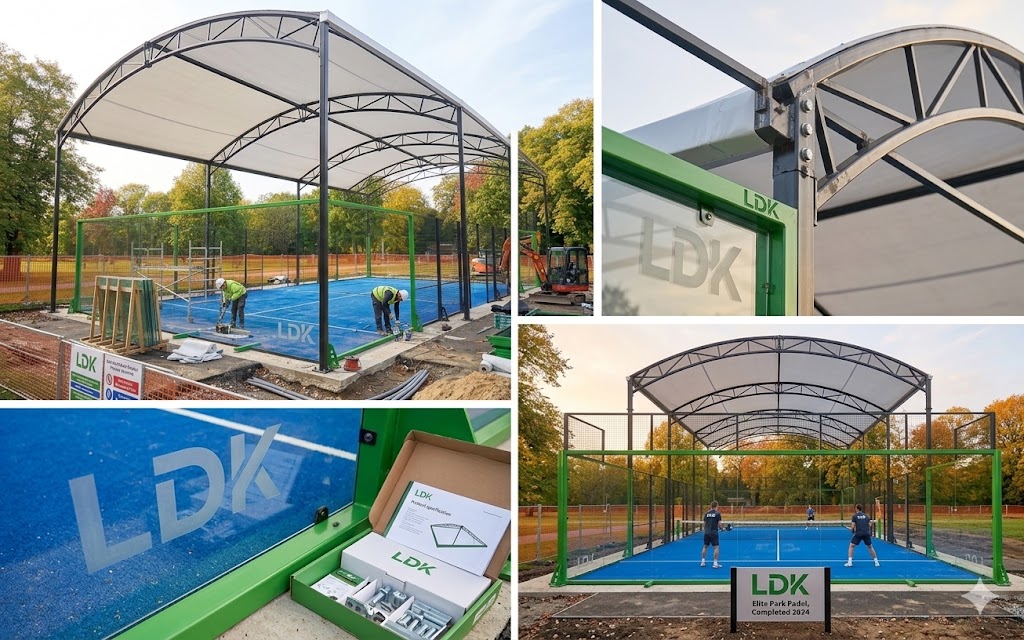
Padel Court Structural Frame Comparison
| Engineering Quality Metric | Standard Economy Padel Courts | Premium Heavy Snow Load Padel Courts |
| Steel Profile Grade | Basic low-tensile carbon steel | High-yield S355 JR structural steel |
| Column Minimum Wall Thickness | 2.0 mm–2.5mm (Risk of bending) | ≥ 3.0 mm thick reinforced columns |
| Anti-Corrosion Finish Standard | Basic spray painting or a thin zinc plate | EN ISO 1461 hot-dip galvanization (≥ 85 μm) |
| Fabrication Sequence | Pre-galvanized steel cut after coating | Full dipping after all cutting and welding |
| Extreme Weather Lifespan | Low, rust, and heavy snow warp frames | High; delivers decades of safe operation |
Conclusion: Future-Proof Your Sports Infrastructure Investment
In conclusion, building a successful, highly profitable sports venue requires sourcing rugged structural hardware that easily withstands challenging winter climates.
Stop risking your development capital and public safety on cheap, thin-walled court kits that rust quickly and sag under heavy winter snow loads. Upgrading your procurement orders to an advanced, certified heavy snow load padel court configuration ensures absolute structural safety and high wind resistance. We engineer every single S355 JR steel frame component to maintain perfect alignment and resist rust across decades of continuous outdoor use. Contact our commercial stadium engineering division today to review your local snow load requirements and secure your custom manufacturing order.