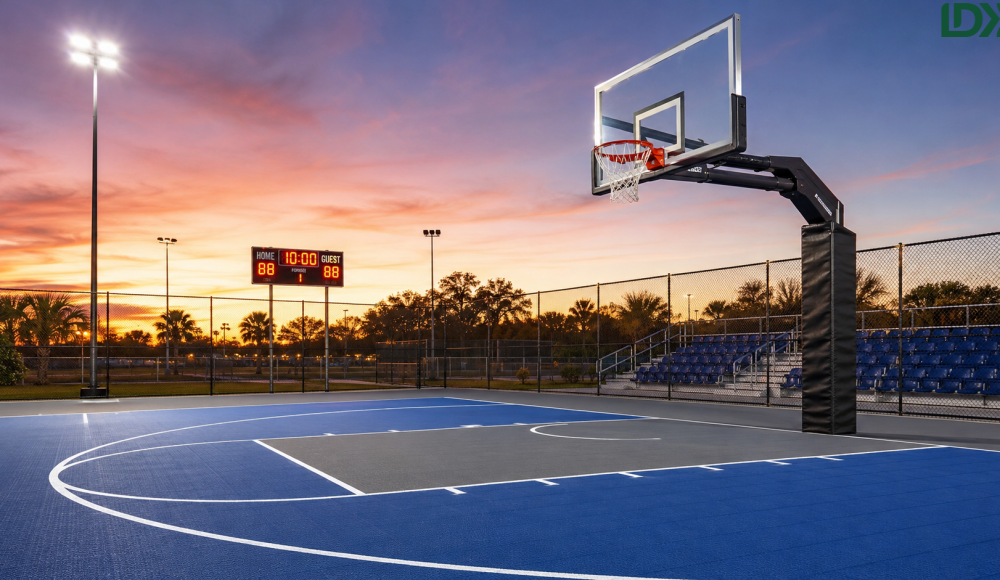
Building a basketball court requires more than installing two hoops and painting court lines.
Whether you are planning a home basketball court, school playground, community sports area, commercial basketball club or indoor gymnasium, you first need to determine:
- How much space is available?
- Will the court be indoors or outdoors?
- Who will use the court?
- Is it intended for recreation, training or competition?
- Which basketball court equipment is essential?
- How can you balance price, performance and long-term maintenance?
A residential half court does not need the same equipment as a school gymnasium or professional arena. Choosing the right basketball hoop, flooring, lighting and accessories according to the actual application can reduce unnecessary costs and improve the court’s safety and service life.
This guide explains the standard basketball court dimensions, essential equipment and common product options for different basketball facilities.
What Is the Standard Basketball Court Size?
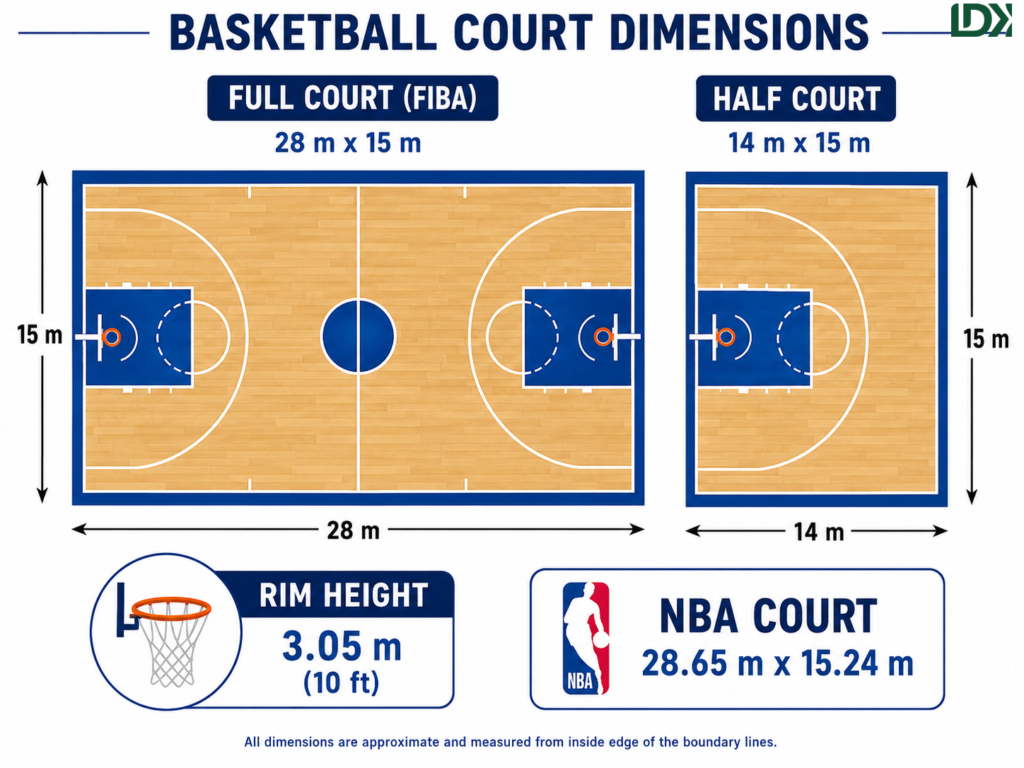
A standard FIBA basketball court measures:
- 28 metres long
- 15 metres wide
- 420 square metres of playing area
Additional safety space should be provided around the playing area. A complete basketball facility therefore requires more space than the marked 28 × 15-metre court.
The standard adult basketball rim height is:
- 3.05 metres
- 10 feet
An NBA basketball court is slightly larger, measuring approximately 28.65 × 15.24 metres.
For most international schools, commercial clubs and community sports facilities, the FIBA 28 × 15-metre layout is the more commonly used reference.
However, not every project needs a full basketball court.
Common Basketball Court Layouts
A full basketball court is suitable for schools, universities, clubs, sports centres and competition venues.
A half basketball court is more suitable for residential backyards, hotels, small schools, training facilities and compact community spaces.
A customized shooting or training court can also be designed when the available site is limited.
For smaller projects, it is usually better to prioritize a safe playing area, stable hoop and level flooring rather than trying to fit full professional court markings into an insufficient space.
Essential Basketball Court Equipment Checklist
A complete basketball court may include:
- Basketball hoops
- Backboards, rims and nets
- Indoor or outdoor sports flooring
- Court markings
- Court fencing or ball-stop netting
- LED sports lighting
- Scoreboard and shot clocks
- Team benches and scorer’s table
- Spectator seating
- Protective padding
- Basketball racks and training accessories
The final equipment list should be based on the court type, usage frequency, player age, budget and competition level.
1. Basketball Hoops and Backstop Systems
The basketball hoop is the most important piece of equipment on the court.
A complete basketball goal system usually consists of:
- Steel support structure
- Backboard
- Basketball rim
- Net
- Base or anchoring system
- Protective padding
- Height-adjustment or folding mechanism where required
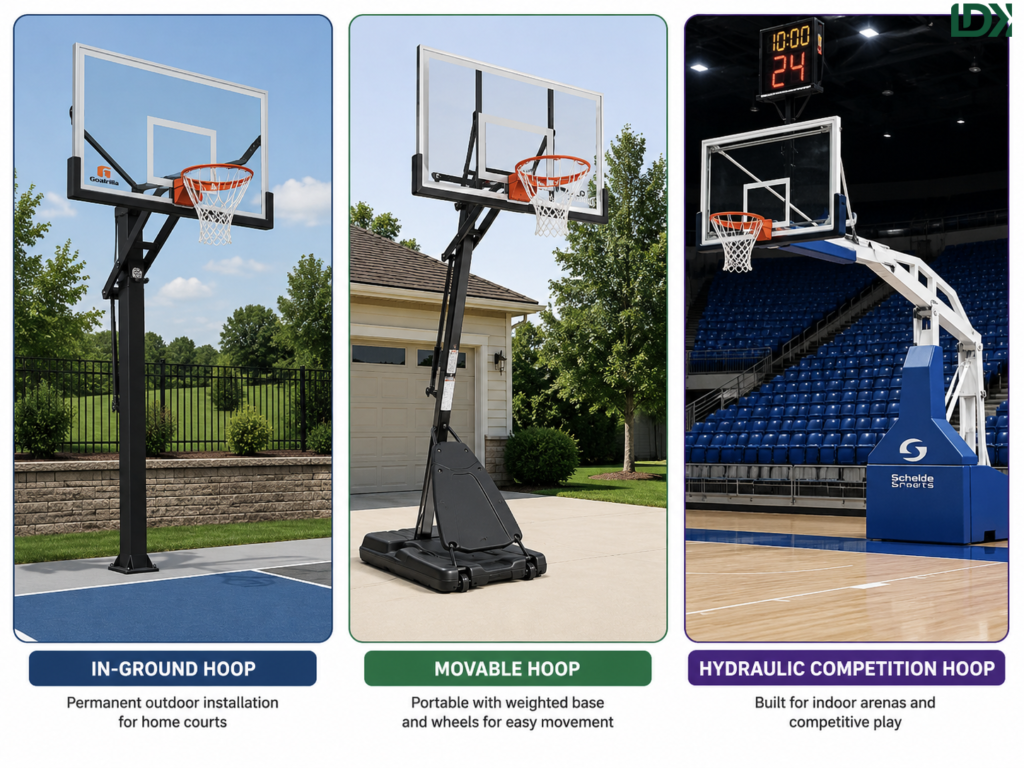
The two most common categories are outdoor fixed or movable hoops and indoor competition basketball backstops.
Outdoor Basketball Hoops
Outdoor courts commonly use either an in-ground basketball hoop or a movable basketball stand.
In-Ground Basketball Hoop
An in-ground basketball hoop is fixed into a concrete foundation.
It is suitable for:
- Residential courts
- Schools
- Public parks
- Community sports facilities
- Permanent outdoor courts
Its main advantages are good stability, simple maintenance and efficient use of space around the court.
For outdoor applications, the steel structure should have suitable anti-corrosion treatment, while the foundation must be designed according to the hoop weight, projection length and local wind conditions.
Height-Adjustable Movable Basketball Stand
A movable basketball stand uses a weighted base and transport wheels.
It is suitable for:
- Schools
- Sports clubs
- Multi-purpose courts
- Training centres
- Facilities serving different age groups
A commercial movable stand is much heavier and more stable than a small residential portable hoop.
For example, the LDK10013 movable basketball stand includes:
- Adjustable basket height from approximately 2.45 to 3.05 metres
- Approximately 1829 × 1070 × 12 mm tempered-glass backboard
- 450 mm basketball rim
- High-strength steel support structure
- Approximately 40 mm protective padding
- Approximately 500 kg counterweight
- Four transport wheels
This configuration is suitable for school, club and community courts that require both stability and flexible positioning.
Indoor Competition Basketball Hoop
Indoor gymnasiums and competition venues commonly use movable hydraulic basketball backstops.
These systems may include:
- Electric or manual hydraulic folding
- Heavy counterweight base
- Transport wheels
- Tempered-glass backboard
- Elastic basketball rim
- Full protective padding
The LDK10012A hydraulic competition basketball hoop provides:
- Adjustable basket height from approximately 2.44 to 3.05 metres
- Approximately 1.68-metre projection
- 1800 × 1050 × 12 mm tempered-glass backboard
- 450 mm basketball rim
- Foldable and movable structure
- Protective padding
- Corrosion-resistant powder coating
This type is suitable for professional gymnasiums, universities, commercial basketball clubs and multi-purpose arenas.
The folding structure allows the equipment to be stored when the venue is used for volleyball, badminton or other events.
Basketball Backboards and Rims
Tempered-glass backboards are commonly used in schools, clubs and competition venues because they provide clear visibility, good rigidity and consistent ball rebound.
Common backboard sizes include:
- 1800 × 1050 mm
- 1400 × 900 mm
- 1200 × 800 mm
The larger backboard is suitable for adult training and competition, while smaller sizes may be used for youth or recreational basketball.
A standard basketball rim has an internal diameter of approximately 450 mm.
Elastic or breakaway rims are commonly used in schools, clubs and competition venues because the spring mechanism helps reduce excessive impact on the backboard and support structure.
The LDK1026D elastic basketball rim uses approximately 18 mm high-strength solid spring steel with corrosion-resistant powder coating.
2. Basketball Court Flooring
Basketball court flooring affects player comfort, ball rebound, traction, injury risk and maintenance cost.
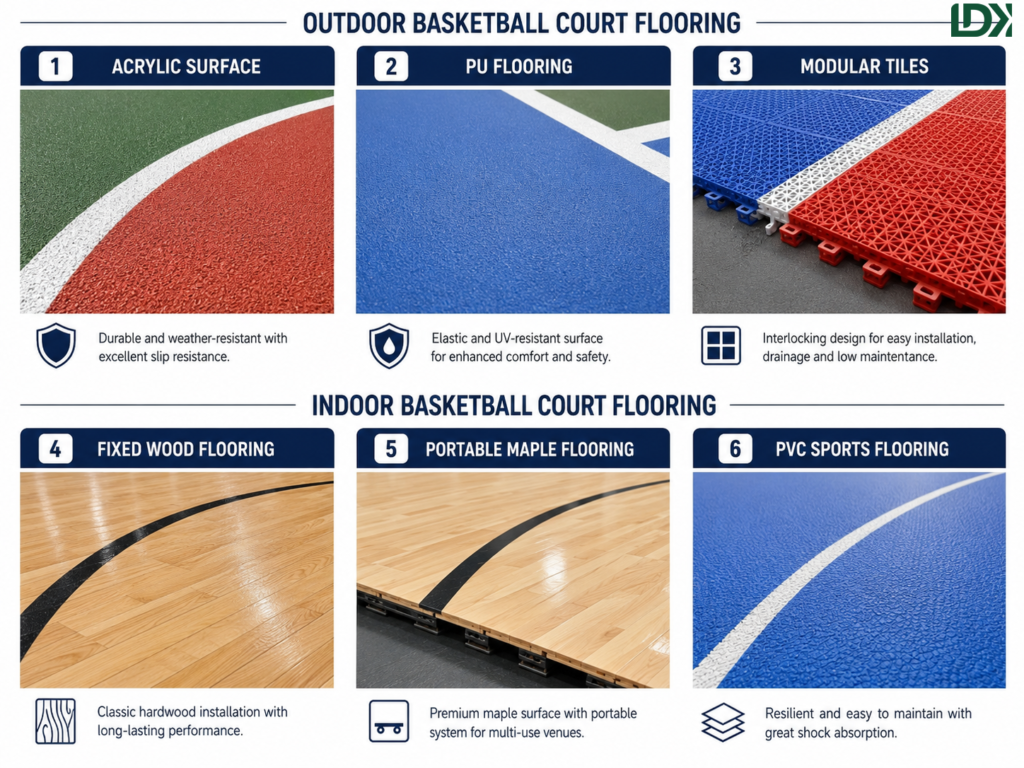
Indoor and outdoor basketball courts require different flooring systems.
Outdoor Basketball Court Flooring
The most common outdoor options are acrylic, PU flooring and modular sports tiles.
Acrylic Basketball Court Surface
Acrylic coatings are installed over concrete or asphalt.
They are commonly used for:
- Schools
- Residential courts
- Community facilities
- Public parks
- Outdoor sports clubs
Advantages include:
- Clear colours and court markings
- Good weather resistance
- Suitable ball rebound
- Relatively simple maintenance
- Competitive initial cost
However, acrylic flooring requires a flat and well-drained base. Cracks or settlement in the concrete may eventually affect the finished surface.
Outdoor PU Basketball Flooring
PU basketball flooring provides a more cushioned surface than plain concrete or basic hard coatings.
A typical system may include:
- Primer
- Elastic layer
- Reinforcement layer
- Wear-resistant surface
- Colour coating
- Court markings
PU flooring is suitable for schools, training centres and sports clubs that want improved player comfort.
When comparing PU systems, buyers should check:
- Total thickness
- Shock absorption
- Ball rebound
- Slip resistance
- UV stability
- Wear resistance
- Repair method
The exact system should be selected according to the climate, base condition and expected usage.
Modular Sports Tiles
Modular polypropylene tiles are another common choice for outdoor courts.
They provide:
- Fast installation
- Good drainage
- Replaceable individual tiles
- Multiple colour options
- Customized logos and court layouts
They are suitable for backyard courts, schools, community areas and renovation projects.
Buyers should compare locking strength, UV resistance, thermal expansion, slip resistance and long-term deformation.
Indoor Basketball Court Flooring
Indoor basketball courts commonly use fixed sports wood flooring, portable wood flooring or PVC sports flooring.
Fixed Sports Wood Flooring
Fixed wood flooring is permanently installed in the gymnasium.
It is commonly used in:
- Schools
- Universities
- Basketball clubs
- Training centres
- Indoor arenas
A sports wood flooring system usually includes a moisture barrier, elastic pads, wooden supports, hardwood boards and sports surface coating.
It provides professional ball rebound and player comfort but requires proper moisture control and regular maintenance.
Portable Competition Wood Flooring
Portable wood flooring consists of modular panels that can be assembled, dismantled, transported and stored.
It is suitable for:
- Temporary tournaments
- Multi-purpose arenas
- Exhibition centres
- Professional events
- Venues that frequently change floor configurations
The LDK10015B1 portable wood sports flooring system includes:
- Selected Canadian maple surface
- Approximately 22 mm maple layer
- Approximately 80 mm total system thickness
- Full panel size of approximately 2160 × 586 mm
- Half panel size of approximately 1080 × 586 mm
- Approximately 14 mm elastic rubber pads
- Pre-marked basketball court lines
- Transport and storage carts
A trained installation team can assemble the system efficiently, making it suitable for venues that require fast event conversion.
PVC Sports Flooring
PVC sports flooring is a practical option for schools, training centres and multi-purpose halls.
Its advantages include:
- Faster installation
- Easier cleaning
- Comfortable surface
- Lower initial cost than hardwood
- Suitability for multiple indoor sports
The selected PVC flooring should be designed specifically for sports use rather than ordinary commercial or residential flooring.
3. Basketball Court Fencing and Ball-Stop Netting
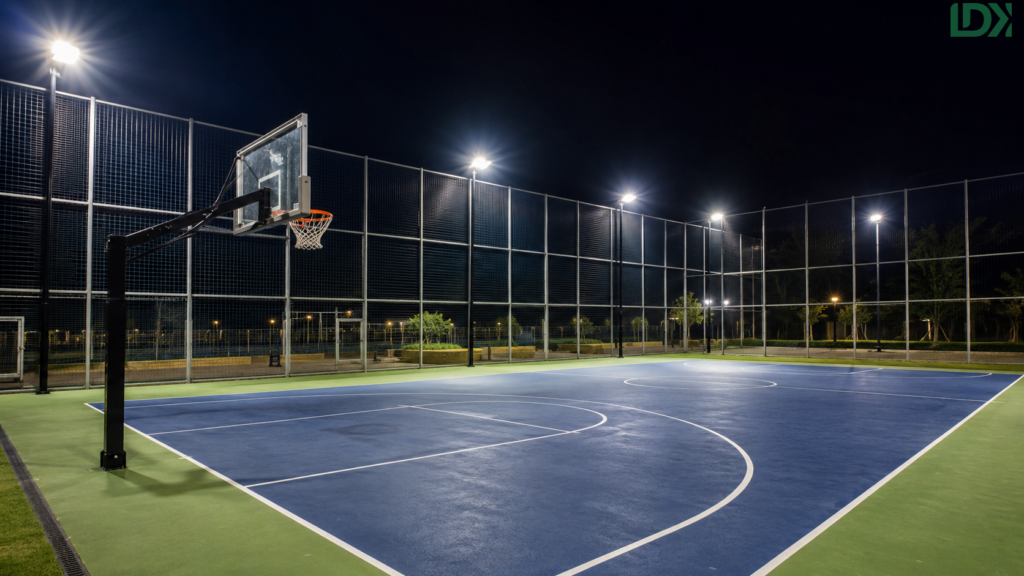
Outdoor basketball courts may require fencing to prevent balls from leaving the playing area.
The two most common options are steel fencing and flexible ball-stop netting.
Steel Court Fencing
Chain-link or welded wire mesh fencing is suitable for:
- Schools
- Community courts
- Public parks
- Commercial sports clubs
Steel fencing provides good durability, access control and protection for surrounding roads, buildings and parked vehicles.
The final design should consider:
- Fence height
- Wire or panel thickness
- Post spacing
- Gate position
- Surface coating
- Wind load
- Foundation design
Flexible Ball-Stop Netting
Flexible netting is often installed behind the basketball hoops or around compact courts.
It is suitable for:
- Residential courts
- Training areas
- Courts with sufficient surrounding space
- Projects that do not require a full steel enclosure
The net should have appropriate UV resistance, mesh size, breaking strength and support cables.
4. Basketball Court Lighting
Good lighting improves ball visibility, player safety and court usability.
Outdoor courts normally use pole-mounted LED floodlights, while indoor courts use roof- or ceiling-mounted sports lights.
Outdoor Court Lighting
The lighting design should consider:
- Court dimensions
- Pole height
- Beam angle
- Light uniformity
- Glare
- Nearby roads and buildings
- Energy consumption
- Maintenance access
Choosing lights only by wattage may create bright spots, dark areas and glare.
A photometric lighting layout is more reliable because it shows how the light will be distributed across the court.
Indoor Court Lighting
Indoor basketball lighting should be coordinated with:
- Roof structures
- Basketball hoop systems
- Scoreboards
- Ventilation ducts
- Cameras
- Spectator seating
- Other sports equipment
Schools and recreational courts require functional and uniform lighting, while professional venues may also require higher colour rendering, flicker control and broadcast performance.
5. Scoreboards, Seating and Other Basketball Accessories
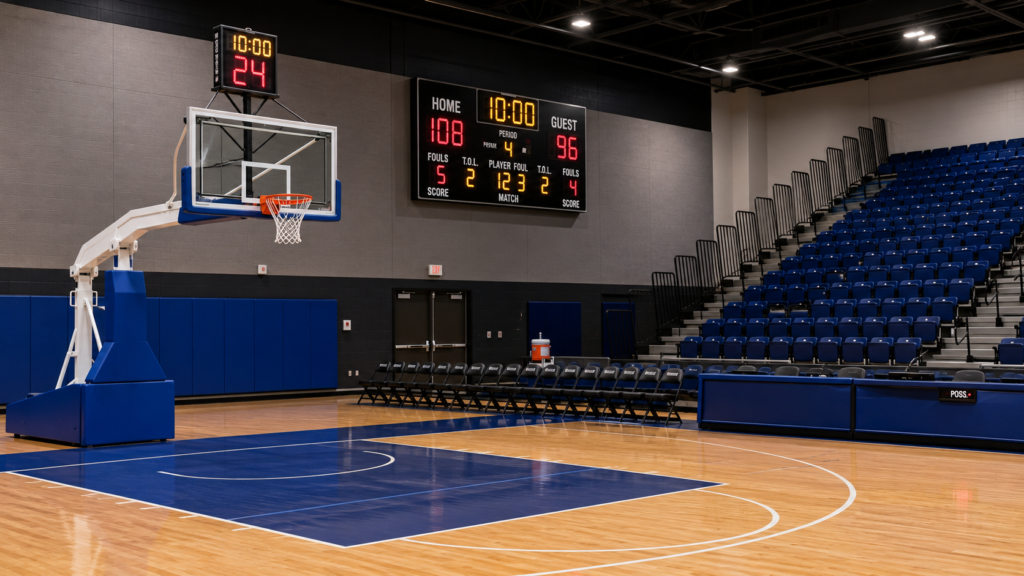
Not every court needs a full electronic scoring or spectator system.
These products are mainly selected for schools, clubs and competition venues.
Basketball Scoreboard
A basic electronic scoreboard may display:
- Home and guest scores
- Game time
- Period
- Team fouls
- Time-outs
Professional venues may also require shot clocks, player foul information and synchronized backboard lights.
Before selecting a scoreboard, confirm:
- Viewing distance
- Indoor or outdoor use
- Display size
- Brightness
- Control method
- Supported game functions
Spectator Seating
Common seating options include:
- Fixed bleachers
- Retractable bleachers
- Portable bleachers
Retractable seating is useful for multi-purpose gymnasiums because it can be folded away when additional floor space is required.
The seating design should also consider aisle width, guardrails, emergency exits, accessible seating and local building regulations.
Other Basketball Accessories
Additional equipment may include:
- Team benches
- Scorer’s table
- Protective padding
- Basketball racks
- Ball carts
- Training cones
- Coaching boards
- Storage cabinets
These products can be selected according to the venue’s training and event requirements.
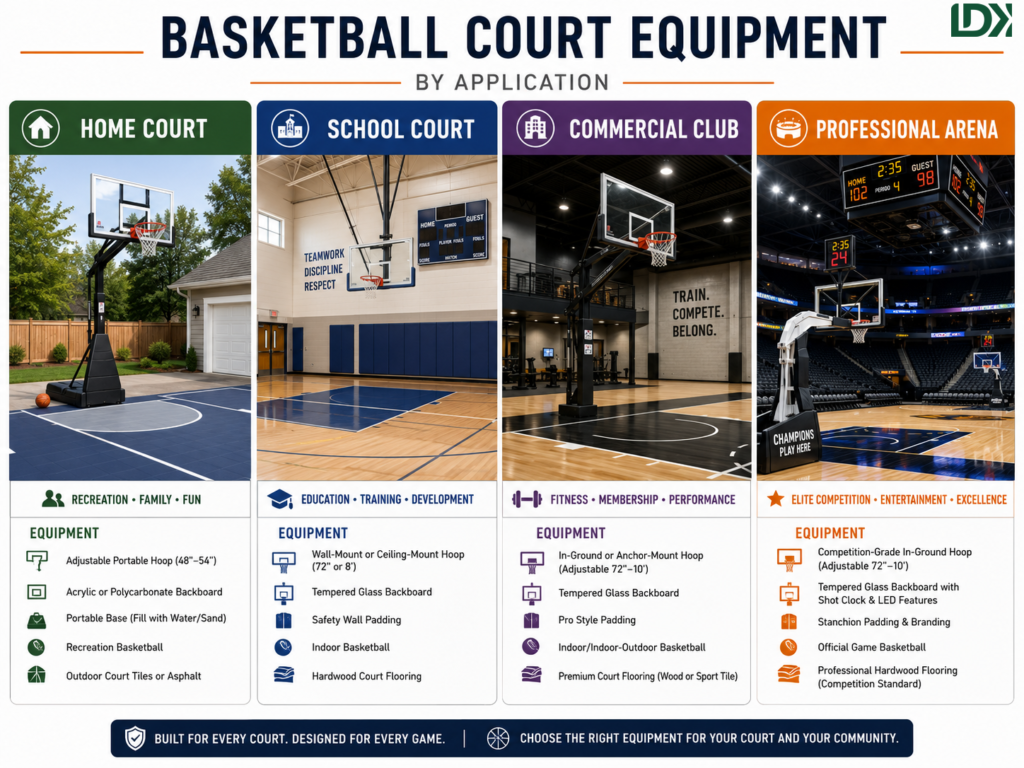
Basketball Court Equipment Recommendations by Application
| Project Type | Recommended Hoop | Recommended Flooring | Other Equipment |
|---|---|---|---|
| Home Basketball Court | Adjustable in-ground hoop | Acrylic, PU or modular tiles | Ball-stop netting and basic LED lighting |
| School Basketball Court | Height-adjustable movable or fixed hoop | PU, PVC or sports wood flooring | Protective padding, scoreboard and team benches |
| Community or Public Court | Heavy-duty in-ground hoop | Acrylic, PU or modular tiles | Fencing, LED lighting and drainage |
| Commercial Basketball Club | Heavy-duty movable or competition hoop | PU, PVC or hardwood flooring | Scoreboard, seating and training accessories |
| Professional Indoor Arena | Hydraulic competition backstop | Fixed or portable hardwood flooring | Shot clocks, scoreboard, competition lighting and seating |
How to Build a Cost-Effective Basketball Court
A cost-effective basketball court is not simply the one with the lowest initial price.
It should provide suitable safety, performance and service life without including unnecessary equipment.
Define the Application First
Before requesting quotations, confirm:
- Available dimensions
- Indoor or outdoor use
- Player age
- Daily usage
- Recreational or competition level
- Maintenance capability
A residential court does not need professional arena equipment, while a public or school facility should not use lightweight residential hoops.
Prioritize the Foundation
For outdoor courts, a poor base can cause:
- Standing water
- Cracks
- Uneven flooring
- Loose tiles
- Coating failure
The concrete or asphalt base should have sufficient strength, flatness and drainage before the finished sports surface is installed.
Focus the Budget on Essential Equipment
When the budget is limited, prioritize:
- Safe basketball hoops
- Level and durable flooring
- Safety clearance
- Drainage
- Protective padding
- Functional lighting
- Fencing where required
Advanced scoreboards and large seating systems can be added later if they are not essential.
Compare Long-Term Cost
A complete cost comparison should include:
- Equipment price
- Shipping
- Installation
- Foundations
- Electrical work
- Maintenance
- Spare parts
- Flooring repair
- Energy consumption
- Replacement cost
A lower-priced product may become more expensive if it requires frequent repairs or early replacement.
Basketball Court Equipment FAQ
What equipment does a basic basketball court need?
At minimum, it needs one or two basketball hoops, a level playing surface, court markings and sufficient safety space.
What is the standard basketball court size?
A standard FIBA basketball court measures 28 × 15 metres.
How high is a basketball hoop?
The standard adult rim height is 3.05 metres.
What is the best outdoor basketball flooring?
Acrylic, PU and modular sports tiles are common choices. The best option depends on climate, budget and expected usage.
What is the best indoor basketball flooring?
Hardwood is suitable for professional use, while PVC flooring is a more economical option for schools and training centres.
Does a basketball court need fencing?
Fencing is recommended when the court is near roads, buildings, parking areas or other sports facilities.
Is a scoreboard necessary?
It is optional for home and recreational courts but recommended for schools, clubs and competition venues.
Can basketball courts be used for other sports?
Yes. They can support volleyball, badminton, pickleball and other activities if the layout is planned properly.
LDK Basketball Court Equipment Solutions
A successful basketball court project requires coordinated planning rather than purchasing each product independently.
LDK provides customized basketball court equipment and integrated facility solutions for residential, school, commercial and professional projects.
Available products include:
- Hydraulic competition basketball hoops
- Movable and in-ground basketball stands
- Height-adjustable youth basketball hoops
- Tempered-glass backboards
- Elastic basketball rims
- Outdoor basketball flooring
- Fixed and portable wood flooring
- Court fencing
- LED sports lighting
- Electronic scoreboards
- Spectator seating
- Protective padding and accessories
The final equipment configuration can be selected according to the project location, court dimensions, indoor or outdoor environment, player age and competition level.
To request a basketball court proposal, provide:
- Project location
- Available dimensions
- Indoor or outdoor installation
- Full court or half court
- Intended users
- Required flooring
- Preferred basketball hoop type
- Lighting, fencing or seating requirements
- Site drawings or photos
Planning a Basketball Court Project?
Share your court dimensions, project location, intended users and required equipment. LDK can recommend a suitable basketball court layout and equipment configuration based on your actual project requirements.