Are you looking for a padel court manufacturer in China but unsure how to compare suppliers? Does a lower price mean lower quality? Is 12 mm glass enough for an outdoor court? What should a professional quotation include?
The short answer is that the best padel court manufacturer is not necessarily the company offering the lowest price. A reliable supplier should provide clear technical specifications, project-specific structural advice, foundation drawings, safe export packaging and installation support.
Here are the most important points to check before placing an order.
1. Verify That the Supplier Can Manufacture the Court
A professional manufacturer should be able to show more than product renderings and catalog pictures.
Ask for:
- Company and factory information
- Live factory video inspection
- Steel cutting and welding processes
- Quality-control procedures
- Current production orders
- Glass and steel packaging methods
- Completed overseas projects
- Installation photographs
A trading company is not automatically unreliable, but you should know which factory is responsible for engineering, production and after-sales service.
Real production videos and completed projects are more valuable than claims such as “No. 1 manufacturer” or “best quality in China.”
2. Check the Court Dimensions and Technical Drawings
A standard doubles padel court has an internal playing area of 20 × 10 meters.
According to the International Padel Federation Rules of Padel:
- The internal court measures 20 × 10 m.
- The end enclosure has a total height of 4 m.
- The lower 3 m is normally glass or another approved rebound wall.
- The upper 1 m is metal mesh.
- The net is 10 m long.
- Net height is 0.88 m at the center and 0.92 m at the ends.
- Minimum clear height above the court is 6 m.
- A clear height of 8 m is recommended for new facilities.
A supplier should provide court-layout, elevation, foundation and anchor drawings before the customer starts concrete construction.
Be careful with general claims such as “FIP standard.” FIP rules define the playing dimensions and enclosures, but the steel structure and foundation must also meet the wind and construction requirements of the project location.
3. Compare the Complete Court Specification
Two panoramic padel courts can look similar but use different steel sections, mesh, turf, glass and coatings.
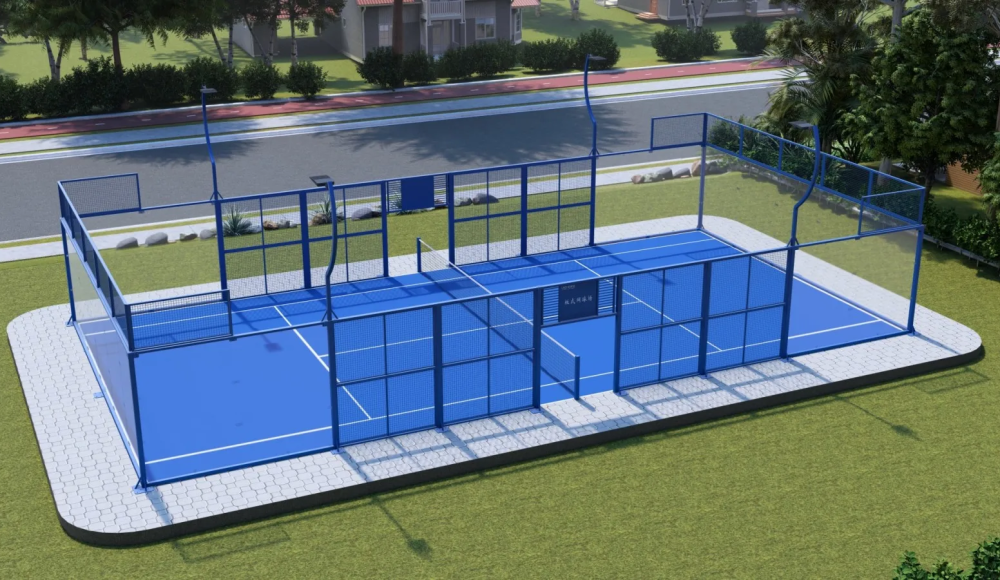
The following is an example of an LDK 20 × 10 m panoramic padel court configuration:
| Component | Specification |
|---|---|
| Tempered glass | 18 panels, 12 mm, 1,990 × 2,980 mm |
| Steel mesh | 46 panels, 1 × 2 m |
| Mesh wire | 4 mm diameter |
| Mesh opening | 50 × 50 mm |
| Corner columns | 80 × 80 × 3 mm, 4 m long |
| Middle and gate columns | 100 × 50 × 3 mm |
| Cross tubes | 100 × 50 × 3 mm |
| Net-post section | 120 × 60 × 3 mm |
| Padel net | 10 m, black PP, 4 mm cord |
| LED lighting | Eight 200 W IP65 lights |
| Artificial turf | 12 mm, 52,500 stitches/m² |
| Turf quantity | 210 m² |
| Surface finish | Electrostatic epoxy powder coating |
| Coating thickness | Approximately 70–80 μm |
| Hardware | Electro-polished stainless steel |
The 210 m² turf supply provides approximately 5% additional material for cutting and installation on the 200 m² playing surface.
When comparing quotations, also ask:
- What steel grade is used?
- Is the glass certified safety glass?
- What is the turf fiber and backing?
- Is silica sand included?
- What corrosion treatment is provided?
- Is the proposed structure suitable for the local wind speed?
- Are foundation anchors included?
- What are the warranty terms?
A detailed specification is more useful than general descriptions such as “premium steel” or “high-quality turf.”
4. Evaluate the Steel Structure and Wind Resistance
The steel structure supports the glass, mesh, gates and lighting system. It also transfers wind loads into the concrete foundation.
Before recommending a structure, the manufacturer should ask for:
- Project country and city
- Indoor or outdoor installation
- Maximum local wind speed
- Distance from the coast
- Number of courts
- Court arrangement
- Roof or canopy requirements
A standard structure may not be suitable for every outdoor location. High-wind or coastal projects may require larger steel sections, additional supports, reinforced anchors or upgraded corrosion protection.
Using 12 mm glass does not automatically make a court safe in strong winds. The glass, steel frame, anchors and foundation must work as one structural system.
5. Check the Glass, Turf and Lighting
Tempered glass
The example court uses 18 certified 12 mm tempered glass panels measuring 1,990 × 2,980 mm.
Ask the manufacturer about:
- Glass safety documentation
- Edge polishing
- Hole positions
- Countersunk fixings
- Rubber protection pads
- Replacement-glass availability
Artificial turf
The example turf has a 12 mm pile height, 3/16-inch gauge, density of 52,500 stitches/m² and PP + NET + black SBR backing.
The manufacturer should also explain the required silica-sand quantity, turf warranty, UV resistance and maintenance method.
LED lighting
Eight 200 W IP65 LED lights provide a total rated power of 1.6 kW.
However, wattage alone does not determine lighting quality. Buyers should also check illuminance, uniformity, glare control, pole positions and electrical voltage.
6. Understand What the Price Includes
The example panoramic padel court quotation lists:
- Standard equipment price: USD 8,500 per set
- Promotional reference price: USD 7,900 per set
This is an equipment-package price, not the complete cost of building and opening a finished padel court.
Depending on the quotation, the following costs may be separate:
- Concrete foundation
- Drainage
- International freight
- Import duties and taxes
- Local transportation
- Installation labor
- Crane and lifting equipment
- Electrical work
- Silica sand
- Technician travel
- Roof or canopy
- Local engineering and permits
Ask the supplier to identify the trade term, such as EXW, FOB or CIF, and list every included and excluded item.
A USD 7,900 equipment quotation cannot be compared directly with a turnkey quotation that includes freight, foundation materials and installation.
7. Review Installation and After-Sales Support
A reliable China padel court manufacturer should provide:
- Foundation drawings
- Anchor-position drawings
- Component labels
- Packing lists
- Installation manuals
- Assembly videos
- Online technical guidance
- Replacement-part support
If on-site installation is required, confirm whether the quotation includes technicians, local workers, tools, cranes, accommodation and travel expenses.
Warranty terms should separately explain coverage for the steel structure, glass, turf, lights, coating and hardware.
Warning Signs to Avoid
Be cautious if a supplier:
- Cannot provide technical drawings
- Uses only product renderings
- Cannot explain its steel dimensions
- Claims one structure is suitable for every wind condition
- Provides no glass documentation
- Describes turf only as “high quality”
- Does not explain price exclusions
- Has no completed project evidence
- Cannot provide installation guidance
- Uses certification logos without supporting documents
Several of these warning signs together may indicate a higher project risk.
Questions to Ask a Padel Court Manufacturer
Before placing an order, ask:
- Are you the manufacturer of the steel structure?
- Can you provide a live factory inspection?
- Which court model is suitable for our location?
- What wind speed is the structure designed for?
- Can you provide foundation and anchor drawings?
- What are the glass dimensions and safety standards?
- What steel grade and coating system are used?
- What does the quotation exclude?
- What installation support is included?
- Can you provide similar completed projects?
- What are the warranty terms?
- Can you supply replacement glass and spare parts?
The quality and detail of the answers can help you identify a reliable long-term supplier.
Frequently Asked Questions
Who is the best padel court manufacturer in China?
There is no single manufacturer that is best for every project. The right supplier depends on the court type, location, wind conditions, budget and installation requirements. Compare technical specifications, engineering support and completed projects before deciding.
Can a Chinese padel court meet FIP requirements?
Yes. A Chinese manufacturer can produce a court using FIP playing dimensions and enclosure requirements. Buyers should verify the drawings, materials and any certification claims for the exact model offered.
How much does a padel court from China cost?
The example panoramic equipment package is quoted at USD 8,500, with a promotional reference price of USD 7,900. Foundations, shipping, installation, duties and site work may be calculated separately.
Is 10 mm or 12 mm glass better?
Both thicknesses can be found in padel court systems. Twelve-millimeter tempered glass provides greater stiffness, but the complete steel structure, fixing method and foundation are equally important.
How can I verify a padel court factory in China?
Request the business license, factory address, live production video, quality-control records, completed projects and export-packaging information. A third-party inspection can also be arranged.
What information is needed for a quotation?
Provide the project location, indoor or outdoor use, court quantity, preferred court type, local wind speed, turf color, lighting requirements, roof requirements, destination port and required installation service.
Request a Padel Court Proposal
Choosing the best padel court manufacturer in China requires more than comparing unit prices. A reliable supplier should provide the right structure, transparent specifications, technical drawings and installation support for your project.
LDK supplies classic, panoramic, reinforced, 360-degree panoramic and roof-integrated padel court systems.