When planning a sports facility, commercial activation, or youth training hub, procurement directors, venue operators, and sports event organizers face a foundational sizing question: “How do we determine the exact dimensions for a custom portable soccer cage to match youth academies, street tournaments, or community venues?”
Choosing the wrong arena dimensions impacts operational revenue, safety clearances, and player engagement. A pitch that is too small restricts fast-paced ball movement during 5v5 matches, while an oversized arena increases transport, storage, and assembly costs for temporary installations.
To maximize facility return on investment (ROI), venue managers must align arena footprints, wall heights, and containment netting with specific game formats. This engineering guide outlines the dimensional formulas, structural specifications, and procurement strategies for deploying a commercial soccer cage project.
How to Choose the Right Commercial Soccer Cage Size
Selecting the right soccer cage dimensions directly affects venue utilization, player capacity, installation costs, and revenue potential.
Commercial soccer cage project use modular wall panels, impact-resistant rebound boards, and perimeter netting to create enclosed playing environments. This structure keeps the ball inside the arena and supports continuous gameplay.
For commercial operators, the ideal cage size depends on the target players, available venue space, event format, and expected utilization rate.
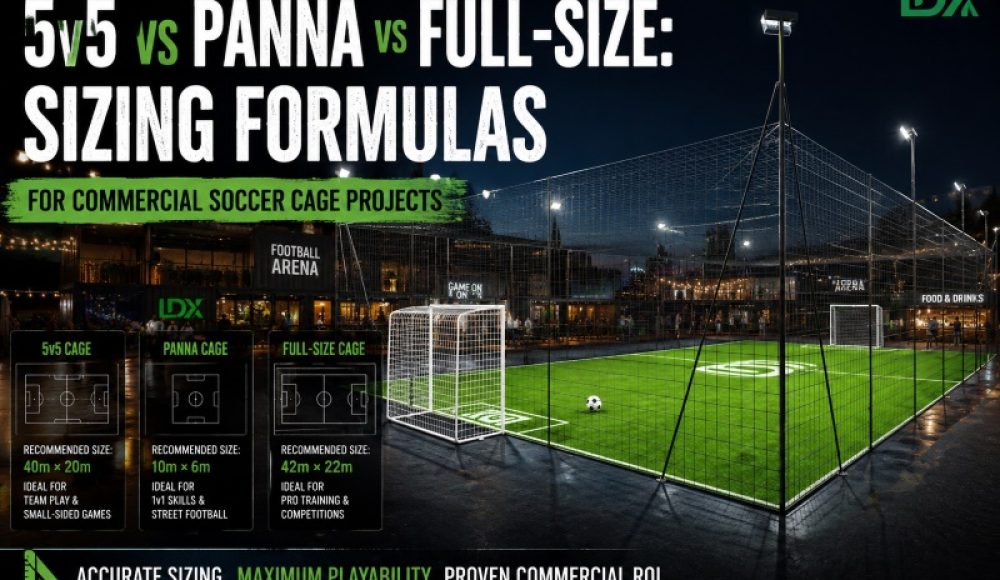
1. Standard Soccer Cage Sizes and Applications
Different soccer cage formats serve different commercial and recreational purposes.
| Soccer Cage Format | Typical Size | Wall Height | Goal Configuration | Main Application |
|---|---|---|---|---|
| Panna Cage | Approx. 3 × 3 m | 1.8–2.4 m | Mini integrated goal | Brand activations and 1v1 games |
| 5v5 Arena | Approx. 12 × 18 m | 1.8–2.4 m | 1.8 × 1.2 m goals | Youth training and court rentals |
| Street Arena | Approx. 18 × 30 m | 2.4–3.0 m | 2.4 × 1.8 m goals | Tournaments and large events |
These configurations allow operators to select a soccer cage based on venue capacity and business objectives.
2. How Rebound Walls Improve Playing Efficiency
Unlike traditional soccer fields, enclosed soccer cages keep the ball within the playing area.
Players can use rebound walls to maintain possession and create faster attacking sequences. This design increases ball touches and reduces interruptions caused by balls leaving the pitch.
As a result, enclosed soccer cages support intensive technical training and continuous commercial gameplay.
They are particularly suitable for youth academies, indoor sports centers, commercial leagues, and event-based soccer activities.
3. Panna Cage: Compact Format for 1v1 and 2v2 Games
A Panna cage provides a compact solution for short-format soccer activities and player skill development.
Typical Panna Cage Dimensions
The standard footprint measures approximately 3 × 3 meters (10 × 10 feet). Manufacturers can also produce circular or octagonal configurations for specialized events.
The cage typically uses 1.8–2.4-meter (6–8 foot) impact-resistant panels with additional containment netting.
Typical Applications
Panna cages work well for:
- Brand activations
- Shopping mall promotions
- Football fan zones
- Trade shows
- Youth skill training
- Pop-up sports events
The compact structure requires limited floor space. Operators can also dismantle and transport the cage between different event locations.
This makes the Panna format particularly useful for mobile marketing and temporary sports installations.
4. 5v5 Soccer Cage: A Versatile Commercial Configuration
The 5v5 soccer cage provides a practical balance between player capacity, venue requirements, and commercial utilization.
A common configuration measures approximately 12 × 18 meters (40 × 60 feet).
The structure typically includes 1.8–2.4 meter rebound panels and optional overhead containment netting. Integrated steel goals can measure approximately 1.8 × 1.2 meters (6 × 4 feet).
Recommended Applications
The 5v5 format suits:
- Youth soccer academies
- School sports programs
- Commercial soccer facilities
- Amateur leagues
- Pay-per-play venues
- Community sports centers
Its moderate footprint allows operators to maximize available space without sacrificing player capacity.
For many commercial venues, the 5v5 configuration provides a strong balance between installation cost and rental utilization.
5. Full-Size Street Arena for Tournaments and Large Events
Large street soccer arenas support higher player capacity and larger organized events.
A typical configuration measures approximately 18 × 30 meters (60 × 100 feet).
The arena uses reinforced perimeter fencing measuring approximately 2.4–3.0 meters (8–10 feet) high.
Heavy-duty structural posts support the enclosure, while integrated goals can measure approximately 2.4 × 1.8 meters (8 × 6 feet).
Recommended Applications
Full-size street arenas are suitable for:
- Municipal sports parks
- Regional tournaments
- Community sports festivals
- Corporate soccer events
- High-capacity sports venues
The larger playing area supports more players and spectators. However, operators must also plan for larger storage areas and specialized transportation.
6. Panna vs. 5v5 vs. Street Soccer Arena
The following comparison helps B2B buyers evaluate different soccer cage configurations.
| Factor | Panna Cage | 5v5 Arena | Full-Size Street Arena |
|---|---|---|---|
| Typical Footprint | Approx. 3 × 3 m | Approx. 12 × 18 m | Approx. 18 × 30 m |
| Venue Space | Approx. 10–15 m² | Approx. 215–250 m² | Approx. 550–650 m² |
| Assembly Time | Under 1 hour | 2–4 hours | 5–8 hours |
| Typical Crew | 2 technicians | 3–4 technicians | 4–6 technicians |
| Main Revenue Model | Sponsorships and activations | Court rentals and leagues | Tournaments and events |
| Transportation | Compact palletized load | Commercial trailer | Multi-pallet transport |
| Typical Players | 2–4 | 10–12 | 12–16 |
Actual installation time and venue requirements can vary according to the cage structure, site conditions, and customization level.
7. How to Select the Right Soccer Cage for Your Business
B2B buyers should evaluate several factors before purchasing a commercial soccer cage.
Consider Available Venue Space
Measure the available installation area before selecting the cage dimensions.
Allow additional clearance around the arena for player access, maintenance, spectator movement, and equipment installation.
Define the Primary Revenue Model
A Panna cage works well for promotional events and short-format activities.
A 5v5 arena better supports recurring court rentals and youth leagues.
A larger street arena suits tournaments, festivals, and high-capacity sporting events.
Evaluate Transportation and Storage
Portable soccer cages require efficient transportation between venues.
Smaller Panna systems can use compact palletized packaging. Larger arenas require commercial trailers or multi-pallet transportation.
Operators should therefore calculate transportation and storage costs alongside the initial equipment investment.
8. Phased Procurement Strategy for Commercial Soccer Facilities
A phased purchasing strategy can help sports venue operators control initial capital expenditure while expanding capacity.
Phase 1: Establish a 5v5 Commercial Arena
Start with a standard 12 × 18 meter 5v5 soccer cage.
This configuration can support youth academies, adult leagues, training programs, and recurring court rentals.
It provides a practical foundation for establishing regular venue revenue.
Phase 2: Add a Portable Panna Cage
Next, add a compact 3 × 3 meter Panna cage.
Operators can deploy it at trade shows, public events, shopping centers, and promotional campaigns.
This mobile format can increase brand exposure while directing potential customers toward the main sports facility.
Phase 3: Expand Into Large-Scale Events
As booking demand grows, consider adding an 18 × 30 meter street soccer arena.
The larger configuration can accommodate regional tournaments, municipal festivals, and corporate sports events.
This expansion strategy allows operators to increase venue capacity without committing to the largest system at the beginning.
Technical Summary
Choosing the right commercial soccer cage requires more than comparing overall dimensions.
Operators should evaluate playing format, venue space, wall height, player capacity, transportation, installation time, and expected revenue.
A 3 × 3 meter Panna cage provides a compact solution for 1v1 games and brand activations.
A 12 × 18 meter 5v5 arena offers a versatile option for youth training, leagues, and commercial court rentals.
An 18 × 30 meter street arena provides greater capacity for tournaments, festivals, and large sporting events.
By matching cage dimensions with operational objectives, sports venue operators can improve space utilization and build a more scalable soccer facility.
LDK designs and manufactures custom commercial soccer cage project, modular sports fencing, rebound panels, and heavy-duty arena systems for commercial sports facilities worldwide.