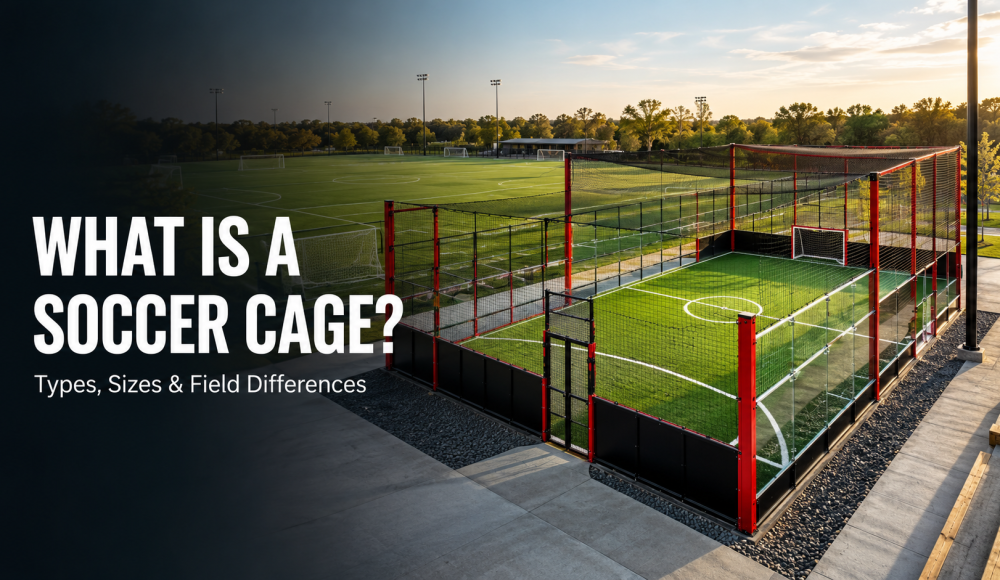
A soccer cage is a compact, enclosed playing area designed for small-sided football games such as 1v1 Panna, 3v3 and 5v5 football. It normally combines a steel or aluminum structure with rebound boards, tempered glass, steel mesh or flexible sports netting.
Unlike a standard soccer field, a soccer cage does not have one mandatory international size. Its dimensions, enclosure, flooring, goals, lighting and accessories can be customized according to the available space and intended application.
This flexibility makes soccer cages suitable for football clubs, schools, community parks, shopping malls, hotels, resorts and commercial sports centers.
What Is a Soccer Cage?
A soccer cage, also called a football cage or cage football pitch, is an enclosed field mainly designed for small-sided football.
A complete soccer cage system may include:
- Steel or aluminum structural frames
- Composite rebound boards
- Tempered glass panels
- Steel mesh or flexible sports netting
- Integrated football goals
- Artificial turf
- Player access doors
- LED floodlights
- Player benches and spectator seating
- Custom colors, logos and advertising panels
The surrounding enclosure helps keep the ball within the playing area. When tempered glass or composite boards are used, players can also use the walls to rebound the ball and continue playing.
A soccer cage is therefore not simply a smaller version of a standard soccer field. It is a customizable sports facility developed specifically for compact sites, small-sided games and continuous play.
Soccer Cage vs. Standard Soccer Field
According to IFAB Law 1, a full-size football field can measure 90–120 m in length and 45–90 m in width. For major stadium fields, FIFA recommends a playing area of 105 × 68 m.
Soccer cages are substantially smaller and do not have one universal field size.
| Feature | Standard Soccer Field | Soccer Cage |
|---|---|---|
| Main game format | 11v11 football | 1v1, 3v3, 5v5 or custom formats |
| Field size | FIFA recommends 105 × 68 m | Customized according to the project |
| Playing boundary | Touchlines and goal lines | Boards, glass, mesh or netting |
| Ball movement | Ball goes out of play | Ball is retained or rebounds from the enclosure |
| Playing surface | Natural or artificial grass | Usually artificial turf or sports flooring |
| Space requirement | Large stadium or training area | Suitable for compact urban sites |
| Customization | Restricted by competition rules | Size, colors, goals and accessories can be customized |
| Main applications | Formal football matches | Training, recreation and commercial operation |
The fence around a standard football field is normally positioned outside the playing area. In a soccer cage, the enclosure forms part of the playing system and is positioned close to the field.
Why Are Soccer Cages Popular?
Soccer cages have become popular because they can bring football into locations where a full-size field would not be practical.
Efficient Use of Space
A soccer cage requires less land than a traditional football field. It can be designed for compact urban areas, indoor sports centers, community parks and converted commercial spaces.
Continuous Gameplay
The enclosure keeps the ball within the playing area. Glass and composite boards can also create controlled rebounds, reducing interruptions and increasing the intensity of the game.
Flexible Customization
The dimensions, frame color, enclosure, goals, turf, lighting, seating and branding can be adapted to different projects.
Multiple Game Formats
The same general system can be developed for Panna, 1v1, 3v3, 5v5 and other small-sided football formats.
Commercial Potential
Sports center operators can generate revenue through field rental, football coaching, memberships, youth programs, tournaments, events and advertising.
Common Soccer Cage Formats and Sizes
Soccer cages can first be classified according to the number of players and the intended style of play.
1v1 Panna Soccer Cage
A Panna soccer cage is a compact round, octagonal or rectangular enclosure developed mainly for one-on-one football.
Depending on the rules, players can win by scoring goals or by playing the ball between the opponent’s legs. The limited space encourages close control, dribbling, quick reactions and individual creativity.
LDK’s LDK20018A Mini/Panna Soccer Cage has a 5 m-diameter playing area that can also be customized.
Its compact dimensions make it suitable for:
- Street football
- Skills training
- School activities
- Shopping malls
- Exhibitions
- Community events
- Football-themed fan zones
3v3 Soccer Cage
A 3v3 soccer cage provides more space for teamwork, passing and tactical movement while retaining the speed of small-sided football.
It is particularly suitable for youth development because every player receives the ball more frequently and participates in both attacking and defending.
There is no universal 3v3 soccer cage size. The final dimensions should be selected according to:
- Player age
- Training objectives
- Available space
- Indoor or outdoor installation
- Goal size
- Local competition requirements
Composite boards, tempered glass and flexible mesh can all be used to build a 3v3 soccer cage.
5v5 Soccer Cage
A 5v5 soccer cage is commonly used by commercial football centers, schools, academies and community sports facilities.
It provides enough space for organized passing, shooting and team tactics while requiring considerably less land than a standard field.
One available LDK tempered-glass configuration measures approximately 25.908 × 12.2 m, or 85 × 40 ft. This is a product configuration rather than a universal 5v5 standard.
The final dimensions should be determined according to the available site and applicable local rules.
What Are the Main Types of Soccer Cages?
Soccer cages can also be classified according to their enclosure materials. The enclosure affects ball rebound, spectator visibility, ventilation, maintenance and project cost.
Mini/Panna Soccer Cage
The LDK20018A Mini/Panna Soccer Cage combines a compact 5 m-diameter playing area with steel rebound panels and upper netting.
Dimensions and Structure
- Field size: Ø5 m or customized
- Main structure: eight Ø48 × 2.0 mm steel posts
- Total enclosure height: 2.2 m
- Access door: included
- Soccer goals: included
Enclosure
The lower enclosure consists of 800 mm-high steel rebound panels, with an additional 200 mm-high steel section above.
The upper enclosure uses 1.2 m-high flexible netting with:
- 4.0 mm net cord
- 100 × 100 mm mesh
Main Features
- Compact footprint
- Suitable for 1v1 Panna football
- Steel-panel ball rebound
- Ball-retention netting
- Custom colors and branding opportunities
- Suitable for indoor and outdoor locations, subject to project design
Recommended Applications
This configuration is suitable for schools, shopping malls, community events, football academies, exhibitions and street football projects.
Tempered Glass Soccer Cage
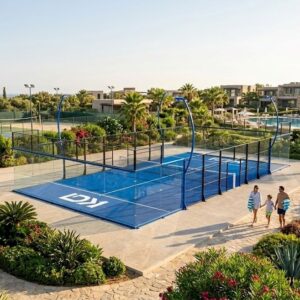
A tempered glass soccer cage combines transparent rebound walls with an upper ball-retention net.
It provides better visibility for spectators and creates a modern appearance for premium commercial football venues.
Dimensions and Structure
- Field size: 25.908 × 12.2 m (85 × 40 ft)
- Main posts: Ø76 × 2.5 mm round steel tubes
- Total enclosure height: 4 m
- Access doors: three doors measuring 1.2 × 2.2 m
- Soccer goals: included
Enclosure
The system uses 12 mm tempered glass panels:
- 2 m high at the two goal ends
- 1 m high along the two long sides
The remaining upper enclosure uses 4.0 mm flexible netting with a 100 × 100 mm mesh.
Main Features
- Clear spectator visibility
- Consistent hard-wall rebound
- Modern commercial appearance
- Ball-retention upper netting
- Suitable for custom lighting and branding
- Appropriate for frequent club and commercial use
Recommended Applications
Tempered glass soccer cages are suitable for premium football clubs, commercial sports centers, schools, resorts, residential developments and modern recreation facilities.
The glass, structural frame and foundation should be engineered according to the project and local safety requirements.
Euro-Style Composite Board Soccer Cage
A Euro-style soccer cage uses solid composite rebound panels around the lower section of the field and flexible netting above.
This configuration provides continuous gameplay while offering greater privacy and more space for club or sponsor branding.
Dimensions and Structure
- Field size: 50 × 20 m or customized
- Main posts: 100 × 100 × 5.0 mm square steel tubes
- Total enclosure height: 4 m
- Access door: 1.2 × 2.2 m
- Soccer goals: included
Enclosure
The lower enclosure uses 1 m-high composite panels.
Each panel is:
- 50 mm thick
- Made with a high-strength foam core
- Faced with steel sheet
- Supported by a reinforced structure
The upper enclosure uses 4.0 mm flexible netting with a 100 × 100 mm mesh.
Main Features
- Durable solid rebound panels
- Continuous ball movement
- Suitable for large playing areas
- Custom panel colors
- Advertising and club-branding opportunities
- Optional lighting, seating and artificial turf
Optional Equipment
- Four-seat steel player benches
- 100–200 W LED floodlights with aluminum housings
- 6 m hot-dip galvanized lighting poles
- Infill artificial turf
- Non-infill artificial turf
Optional equipment is quoted separately according to the project requirements.
Recommended Applications
The Euro-style system is suitable for football clubs, academies, schools, commercial sports centers, community parks and municipal projects.
Cost-Effective Flexible Mesh Soccer Cage
The LDK20017D flexible mesh soccer cage uses high-strength sports netting instead of tempered glass or solid rebound panels.
It is a practical option for projects that prioritize ball containment, ventilation, visibility and cost control.
Dimensions and Structure
- Field size: 50 × 20 m or customized
- Main structure: high-grade round steel posts
- Total enclosure height: 4 m
- Access door: 1.2 × 2.2 m
- Soccer goals: included
- Fasteners: high-grade stainless steel
The diameter, wall thickness and surface treatment of the main posts are selected according to the final structural design.
Enclosure
The enclosure uses flexible sports netting with:
- 4.0 mm net cord
- 100 × 100 mm mesh
- 4 m total height
Main Features
- Cost-effective enclosure system
- Good airflow
- Clear visibility
- Effective ball containment
- Suitable for large customized fields
- Lower amount of solid enclosure material
- Optional lighting, seating and artificial turf
Unlike tempered glass and composite panels, flexible netting mainly contains the ball and does not provide the same hard or consistent rebound.
Optional Equipment
- Four-seat steel player benches
- 100–200 W LED floodlights
- 6 m hot-dip galvanized lighting poles
- Infill artificial turf
- Non-infill artificial turf
Recommended Applications
The flexible mesh soccer cage is suitable for schools, academies, community parks, outdoor training centers, commercial football facilities, hotels and municipal recreation projects.
Where Can Soccer Cages Be Installed?
Customized soccer cages can be used in a wide range of commercial and public environments.
Football Clubs and Academies
Clubs can use soccer cages for technical training, small-sided games, youth development and commercial field rental.
Schools and Universities
Small-sided fields give students more opportunities to participate and require less space than full-size football fields.
Kindergartens and Youth Centers
Compact cages can be customized with smaller goals, suitable dimensions and age-appropriate surfaces.
Community Parks
Mesh and composite-board systems can provide enclosed football areas for public recreation projects.
Shopping Malls and Entertainment Centers
Mini/Panna cages can be used as interactive attractions, branded sports experiences or temporary events.
Hotels and Resorts
A customized soccer cage can expand the sports activities available to guests without requiring a full-size field.
Commercial Sports Centers
Operators can combine field rental, coaching, memberships, tournaments and sponsor advertising to develop multiple revenue streams.
LDK Soccer Cage Technical Specifications
| Specification | Mini/Panna Cage | Tempered Glass Cage | Composite Board Cage | Flexible Mesh Cage |
|---|---|---|---|---|
| Product model | LDK20018A | Custom configuration | Custom configuration | LDK20017D |
| Field size | Ø5 m or customized | 25.908 × 12.2 m | 50 × 20 m or customized | 50 × 20 m or customized |
| Main posts | Ø48 × 2.0 mm steel | Ø76 × 2.5 mm round steel | 100 × 100 × 5.0 mm square steel | Round steel posts |
| Lower enclosure | Steel panels | 12 mm tempered glass | 50 mm composite panels | Flexible sports netting |
| Net specification | 4.0 mm; 100 × 100 mm | 4.0 mm; 100 × 100 mm | 4.0 mm; 100 × 100 mm | 4.0 mm; 100 × 100 mm |
| Total height | 2.2 m | 4 m | 4 m | 4 m |
| Access doors | Included | Three 1.2 × 2.2 m doors | 1.2 × 2.2 m | 1.2 × 2.2 m |
| Soccer goals | Included | Included | Included | Included |
| Rebound performance | Steel-panel rebound | Strong glass rebound | Strong board rebound | Limited soft-net rebound |
| Main advantage | Compact 1v1 play | Premium visibility | Durability and rebound | Ventilation and cost control |
| Recommended use | Panna and skills training | Premium commercial venues | Clubs and public facilities | Schools, parks and training centers |
| Optional equipment | Branding | Lighting and branding | Turf, lights, poles and benches | Turf, lights, poles and benches |
The dimensions above are LDK product configurations and can be adjusted according to the site. They should not be presented as universal soccer cage standards.
What Flooring Is Best for a Soccer Cage?
Artificial turf is the most common flooring option because it provides familiar football performance, consistent ball movement and good durability.
LDK can provide both infill and non-infill soccer artificial turf.
Infill Artificial Turf
Infill turf normally uses sand and performance infill to support the fibers and influence ball movement and shock absorption.
It is suitable for permanent and frequently used football facilities but requires regular brushing, cleaning and infill management.
Non-Infill Artificial Turf
Non-infill turf uses a dense fiber structure and does not require conventional performance infill.
It may be considered for selected indoor, rooftop and compact commercial projects. Buyers should still evaluate traction, shock absorption, surface temperature and maintenance requirements.
Other Sports Flooring
PP interlocking tiles, acrylic systems and PU sports flooring may be considered for community or multi-sport projects.
However, these surfaces create a different football experience from artificial turf and should be selected according to the intended users.
Base and Drainage Requirements
Regardless of the final surface, the supporting base should be:
- Level and structurally stable
- Properly drained
- Free from major cracks
- Suitable for the selected anchoring system
- Designed for indoor or outdoor conditions
Poor drainage or an uneven base can reduce surface performance and shorten the service life of the field.
How to Choose the Right Soccer Cage
The best system depends on how and where the field will be used.
1. Measure the Available Site
Measure the total project area rather than only the desired playing area. Allow additional space for doors, lighting poles, maintenance access, benches and spectators.
2. Select the Game Format
Choose between Panna, 1v1, 3v3, 5v5 or a larger customized training format.
The age and number of players will affect the required field size, goal dimensions and enclosure height.
3. Compare the Enclosure Materials
Choose tempered glass when visibility and premium appearance are priorities.
Choose composite boards when continuous rebound and panel durability are important.
Choose flexible mesh when ventilation, ball containment and cost control are the main requirements.
Choose a mini/Panna cage for compact 1v1 training and event applications.
4. Consider Indoor and Outdoor Conditions
Outdoor projects should consider:
- Local wind conditions
- Corrosion protection
- UV resistance
- Drainage
- Foundation design
- Surface temperature
- Lighting requirements
Indoor projects should consider ceiling height, noise, access, ventilation and fire-safety requirements.
5. Confirm Optional Equipment
Determine whether the project requires:
- Artificial turf
- LED floodlights
- Lighting poles
- Player benches
- Spectator seating
- Additional access doors
- Custom frame colors
- Club logos
- Sponsor advertising panels
What Information Is Needed for a Soccer Cage Quotation?
Providing complete project information will help the manufacturer recommend a suitable system and prepare a more accurate quotation.
Before requesting a quotation, prepare:
- Project country and city
- Available site length and width
- Indoor or outdoor location
- Intended number and age of players
- Preferred game format
- Preferred enclosure material
- Artificial turf requirements
- Lighting and seating requirements
- Required colors and branding
- Expected installation schedule
Site photographs, drawings and foundation information can also help the design team evaluate the project.
Frequently Asked Questions
Is there a standard soccer cage size?
No. There is no single international size for every soccer cage. Dimensions are normally customized according to the site, number of players, player age and intended application.
What is the difference between a soccer cage and a standard soccer field?
A standard field is mainly designed for 11v11 football and uses marked boundary lines. A soccer cage is smaller and uses boards, glass, mesh or netting to enclose the playing area.
Which soccer cage enclosure is best?
Tempered glass is suitable for premium visibility and rebound play. Composite boards provide strong rebound and branding space. Flexible mesh offers ventilation and cost control. The best choice depends on the project.
Can a soccer cage be installed outdoors?
Yes. Outdoor systems require appropriate structural design, corrosion protection, drainage, UV-resistant materials and foundations suitable for local conditions.
Is tempered glass suitable for football impact?
Properly engineered systems can use 12 mm tempered safety glass. The glass, supporting frame, fasteners and foundation must be selected according to the project and local safety requirements.
Can the dimensions and colors be customized?
Yes. Field dimensions, enclosure height, frame colors, doors, goals, turf, lighting and branding can be customized.
What flooring is recommended?
Artificial turf is the most common option. Infill and non-infill systems are available, and the final selection should depend on usage, climate, maintenance and performance requirements.
Are lights, benches and artificial turf included?
These items depend on the selected configuration. For the composite-board and flexible-mesh systems described above, lighting, benches, lighting poles and artificial turf are optional and quoted separately.
Get a Custom Soccer Cage Design and Quotation
Are you planning a soccer cage for a football club, school, community park, hotel or commercial sports center?
LDK provides customized solutions covering structural frames, enclosure systems, football goals, artificial turf, LED lighting, benches and installation support.
Explore our soccer cage systems and global football cage projects.
To receive a customized design and quotation, contact the LDK team with your project location, available site dimensions, intended game format and preferred enclosure type.