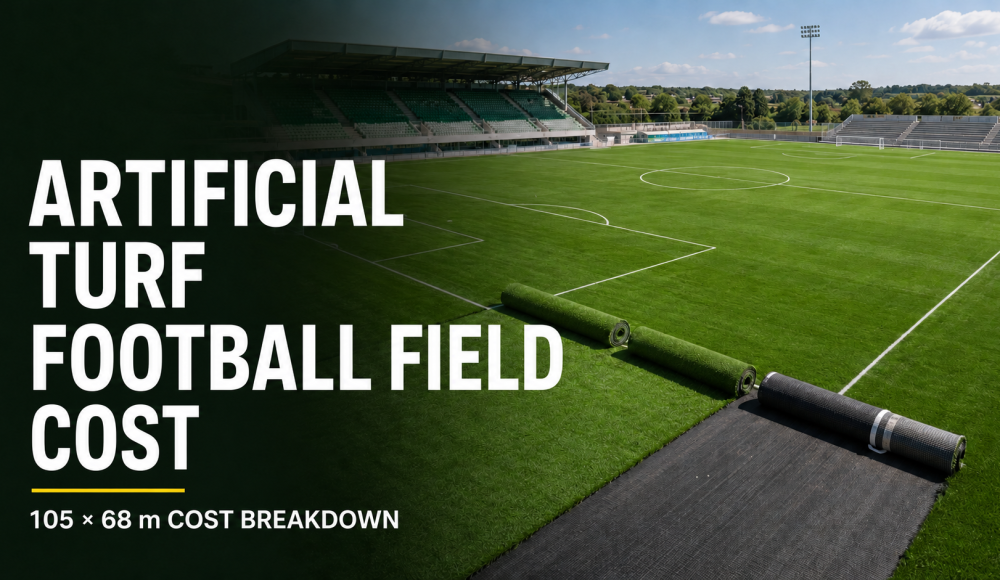
How much does it cost to cover a standard football field with artificial turf? A FIFA-recommended 105 × 68 m field of play covers 7,140 m². After adding a 5% allowance for cutting, line installation and roll layout, the estimated turf order quantity is 7,497 m². Based on the four 50 mm football turf options in LDK’s July 2026 quotation, the turf-only EXW material cost ranges from approximately USD 29,913 to USD 95,212.
This figure covers the artificial grass material only. It does not include the surrounding turf area, sub-base, drainage, shock pad, infill, seaming materials, installation labor, freight, import tax, goals, fencing or lighting. The final installed cost therefore depends on the site conditions and complete system design.
Standard Football Field Size and Turf Quantity
FIFA recommends a field-of-play size of 105 × 68 m. This is widely used for professional 11-a-side football projects.
- Field length: 105 m
- Field width: 68 m
- Playing area: 105 × 68 = 7,140 m²
- Example cutting and layout allowance: 5% = 357 m²
- Estimated turf order quantity: 7,140 × 1.05 = 7,497 m²
The 5% allowance is an estimating assumption, not a fixed rule. The final quantity should be calculated from the supplier’s roll width, roll layout and line-marking plan. In addition, a stadium’s total grassed area may extend beyond the touchlines and goal lines for player safety, warm-up areas and assistant referee movement. These surrounding areas must be measured separately and will increase the order quantity.
Artificial Turf Material Cost for a 105 × 68 m Football Field
The cost calculation is:
Artificial turf material cost = 7,497 m² × turf price per m²
The following comparison uses four 50 mm infill football grass models from the quotation. The displayed figures are EXW reference material prices and are not a binding offer.
| Model | Suggested Quality Level | Dtex | Density | Warranty | EXW Turf Price | Cost for 7,497 m² |
|---|---|---|---|---|---|---|
| LDK50SWJ-TCA4E | Entry / budget | PE 8,800 | 10,500 stitches/m² (±10%) | 5–6 years | USD 3.99/m² | USD 29,913.03 |
| LDK50SWJ-TCA4 | Standard project grade | 10,000 | 10,500 stitches/m² (±10%) | 8 years | USD 6.55/m² | USD 49,105.35 |
| LDK50SWJ-TCD6A | Heavy-duty commercial | 15,000 | 10,500 stitches/m² (±10%) | 8 years | USD 10.70/m² | USD 80,217.90 |
| LDK50SWJ-TCD6AV | Premium / high traffic | 16,000 | 12,600 stitches/m² (±10%) | 8 years | USD 12.70/m² | USD 95,211.90 |
All four quoted models have a 50 mm pile height, 5/8-inch gauge, double-green color and a PP + NET + SBR latex backing system. The main price differences are associated with yarn Dtex, stitch density and warranty positioning.
The premium option costs approximately USD 65,299 more than the entry option for the same estimated order quantity. However, choosing turf only by the initial price can be misleading. A busy commercial field may benefit from higher yarn content and greater density, while a controlled-use training field may not require the most expensive specification.
What Is Included in the USD 29,913–95,212 Estimate?
The estimate includes only the artificial turf rolls calculated from:
- A 105 × 68 m playing area
- A 5% estimating allowance
- The quoted EXW unit price
EXW means the buyer is responsible for transport and most other costs after the goods are made available at the supplier’s location. Buyers should not treat the EXW turf value as the complete cost of building a football field.
What Additional Costs Are Required for a Complete Installation?
1. Site Preparation and Earthwork
The installation area must be stable, level and suitable for drainage. Depending on the existing site, the project may require excavation, soil improvement, compaction, grading and removal of unsuitable material. A flat existing sports base will cost less to prepare than an undeveloped or poorly drained site.
2. Sub-Base Construction
The sub-base supports the complete playing system. It may include compacted aggregate and, depending on the design, asphalt or concrete layers. Thickness, material and construction method should be determined by local ground conditions, climate and engineering requirements.
3. Drainage System
Drainage may include field grading, permeable base layers, drainage pipes, collection channels and discharge connections. Heavy rainfall, soil permeability and local regulations can significantly affect this cost. Good drainage also protects seams and helps keep the field available after rain.
4. Shock Pad
A shock pad can be installed beneath the turf to support impact performance, consistency and long-term system stability. Whether it is required depends on the project standard, turf system and performance target. The shock pad should be evaluated as part of the complete field system rather than as an isolated accessory.
5. Sand and Performance Infill
A 50 mm football turf system normally works with specified infill materials. The required type and quantity depend on the turf, shock pad, target performance and maintenance plan. The quotation used in this guide lists the grass specifications but does not state an infill quantity, so this cost must be calculated separately.
6. Seaming Materials and Field Lines
Installation requires seaming tape, adhesive, cut-in line material and related accessories. The total depends on the roll layout and number of joints. Poor seam design or unsuitable adhesive can cause expensive field repairs even when the turf itself is good quality.
7. Installation Labor and Equipment
Labor may include unloading rolls, positioning, trimming, seaming, line installation, infill spreading, brushing and final inspection. Local labor rates, access conditions, weather and the availability of turf-installation equipment all influence the price.
8. Freight, Import Charges and Local Delivery
The turf prices in this comparison are EXW. International projects must also budget for factory-to-port transport, ocean or land freight, insurance, import duty, tax, customs clearance, port charges and delivery to the job site.
9. Football Field Equipment
A complete venue may also require football goals, team shelters, fencing, ball-stop netting, LED lighting, scoreboards, seating and maintenance equipment. These items should be separated from the turf installation cost so that buyers can compare quotations accurately.
| Cost Item | Included in Turf-Only Estimate? | Main Cost Driver |
|---|---|---|
| Artificial turf rolls | Yes | Dtex, density, quantity and selected model |
| Site preparation and sub-base | No | Existing ground condition and engineered build-up |
| Drainage | No | Rainfall, soil, field grading and discharge design |
| Shock pad | No | System performance requirement and pad specification |
| Sand and performance infill | No | Required kilograms per m² and local material price |
| Tape, adhesive and field lines | No | Roll layout, seams and field marking design |
| Installation | No | Local labor, equipment, access and schedule |
| Freight, duty and tax | No | Destination, shipping volume and local import rules |
| Goals, fencing and lighting | No | Venue design and equipment specification |
Which Turf Quality Is Suitable for Your Football Field?
Entry-Level Turf: USD 29,913 Material Estimate
The PE 8,800 Dtex model provides the lowest initial turf cost and a quoted warranty of five to six years. It may suit projects with controlled usage and strict initial budgets. Buyers should still confirm the expected daily playing hours, maintenance plan and warranty conditions.
Standard Project Turf: USD 49,105 Material Estimate
The 10,000 Dtex option keeps the same 10,500-stitch density while extending the quoted warranty to eight years. It provides a middle position for schools, community projects, academies and general training fields that need to balance cost and service-life expectations.
Heavy-Duty Commercial Turf: USD 80,218 Material Estimate
The 15,000 Dtex option is positioned for more demanding use. Commercial clubs and training centers operating for many hours may prioritize stronger yarn construction because replacement downtime and lost bookings can cost more than the initial material saving.
Premium High-Traffic Turf: USD 95,212 Material Estimate
The 16,000 Dtex model also increases density from 10,500 to 12,600 stitches/m². It is the highest-specification option in the quotation and may be considered for high-use facilities where surface fullness, yarn content and long-term performance are major priorities.
These usage descriptions are general selection guidance. The final recommendation should be based on the complete playing system, test requirements, daily usage, climate, maintenance resources and project budget.
How to Obtain an Accurate Football Field Turf Quotation
Provide the following information to the supplier:
- Country, city and project location
- Exact field-of-play dimensions
- Width of the surrounding turf or run-off area
- Indoor or outdoor installation
- Existing site and sub-base condition
- Local rainfall, temperature and drainage conditions
- Expected daily and weekly playing hours
- Required competition or performance standard
- Preferred turf quality and target budget
- Required shock pad, infill and installation scope
- Destination port or full delivery address
- Goals, fencing, lighting and other equipment requirements
A reliable supplier should return a detailed bill of quantities rather than only a price per square meter. The quotation should state the turf model, technical specifications, roll layout, order quantity, waste allowance, infill recommendation, accessories, trade term, warranty, production time and installation support.
How to Choose the Right Artificial Turf Supplier
- Compare exact specifications: Check pile height, Dtex, gauge, density, yarn, backing and warranty.
- Request an exact-model sample: The sample, technical sheet, quotation and delivered batch should match.
- Review relevant test reports: Ask for evidence covering the proposed product or complete system.
- Check the roll-layout calculation: This determines the real quantity, seam length and cutting loss.
- Read the warranty: Confirm the claim process, maintenance obligations, exclusions and prorated coverage.
- Evaluate installation support: Ask for drawings, videos, remote guidance or on-site assistance.
- Compare landed cost: Include freight, duty, tax, installation and expected maintenance.
- Review project experience: Look for football fields with comparable size, climate and usage.
You can compare LDK’s football artificial turf options or review the football turf product specification before requesting a project quotation.
Final Cost Summary
For a 105 × 68 m standard football field:
- Net playing area: 7,140 m²
- Estimated order quantity with 5% allowance: 7,497 m²
- Quoted turf price range: USD 3.99–12.70/m² EXW
- Estimated turf-only material cost: USD 29,913–95,212
The actual complete installation cost will be higher after adding the surrounding turf area, base, drainage, shock pad, infill, seaming materials, labor, freight, import charges and football field equipment.
Planning a new football field? Contact LDK with your site dimensions, location and expected usage. Our team can recommend a suitable turf specification and prepare a detailed project quotation.
Frequently Asked Questions
How many square meters of artificial turf are needed for a standard football field?
A 105 × 68 m field of play covers 7,140 m². Using a 5% estimating allowance gives an order quantity of approximately 7,497 m². Additional run-off and surrounding turf areas must be added separately.
How much does the artificial grass alone cost?
Based on the four LDK quotation options, the turf-only EXW material cost for an estimated 7,497 m² order is approximately USD 29,913–95,212.
Does this price include installation?
No. The calculation covers the artificial turf rolls only. Site preparation, drainage, shock pad, infill, seaming materials, installation, transport, taxes and equipment are additional.
Why is there such a large difference between turf prices?
The quoted models range from PE 8,800 to 16,000 Dtex and from 10,500 to 12,600 stitches/m². Warranty positioning also ranges from five-to-six years to eight years. Higher yarn content and density generally increase the material cost.
Is 50 mm artificial turf suitable for football?
Yes, 50 mm infill turf is a common football-field format. The complete system must still be matched with suitable infill, base construction, drainage and performance requirements.
How can I receive an accurate installed price?
Send the supplier the field and surrounding-area dimensions, project location, site condition, expected use, required standard, installation scope and delivery destination. A project-specific bill of quantities is required for an accurate installed price.