Event organizers and recreation managers often face the same challenge during outdoor sports seasons.
How can they quickly transform open spaces into professional soccer venues without permanent construction?
With the 2026 World Cup approaching, football activities are expanding worldwide. Therefore, demand for temporary soccer events, fan zones, and youth clinics continues to grow. However, building a temporary venue requires more than fast installation.
Operators must also consider structural stability, wind resistance, and player safety. Meanwhile, traditional construction methods require high costs and long preparation times. As a result, modular portable soccer cages provide a flexible alternative for temporary events. These systems can quickly convert parking lots, parks, and plazas into functional soccer arenas.
In addition, they support commercial events, community programs, and brand activations. This technical guide explains surface preparation, assembly procedures, and ballast anchoring methods. It also provides practical procurement insights for temporary sports facility projects.
By selecting the right portable soccer cage system, operators can create safe and efficient venues.
1. Why Portable Soccer Arenas Drive Event Return on Investment
Permanent sports facilities require extensive real estate, lengthy permitting processes, and substantial capital expenditure. In contrast, modular enclosure systems unlock revenue opportunities in temporary high-foot-traffic locations.
+-----------------------------------------------------------------------------------------+
|                Mobile Soccer Arena vs. Permanent Facility Profile                       |
+---------------------+-------------------------------------------------------------------+
| Operational Aspect  | Portable Soccer Cage System   | Permanent Steel Field Enclosure   |
+---------------------+-------------------------------------------------------------------+
| Setup / Teardown    | 30 to 90 minutes (Modular)    | Fixed permanent civil engineering |
| Surface Versatility | Asphalt, grass, turf, indoor  | Dedicated sub-base foundation     |
| Ground Interventions| Zero damage (Ballast weights) | Concrete footings & soil excavation|
| Asset Mobility      | Transportable via trailer     | Non-relocatable asset             |
+---------------------+-------------------------------------------------------------------+
Reaching Unused Urban Spaces
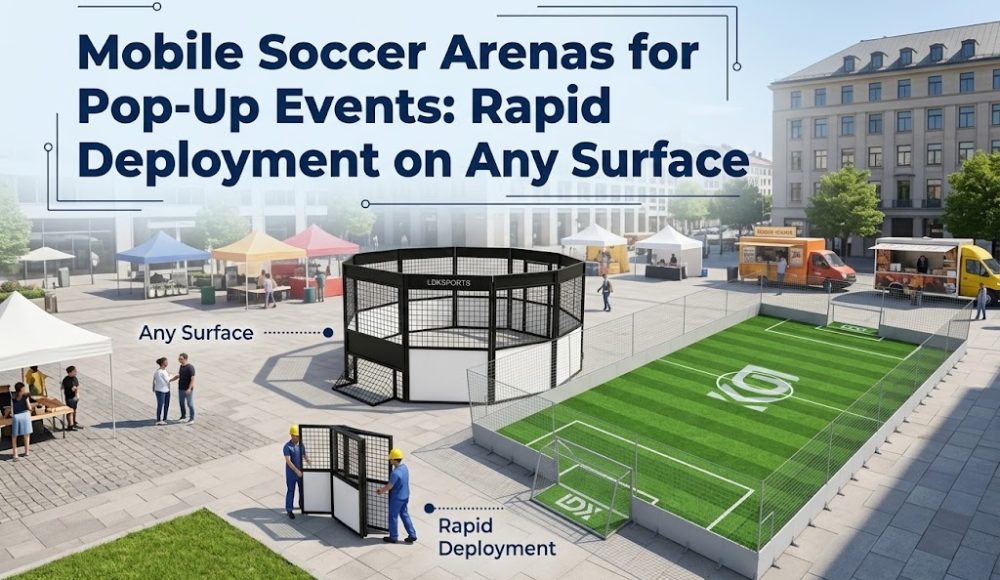
Modular cage systems allow event organizers to bring 1v1 Panna competitions, 5v5 street leagues, and brand fan zones directly to target audiences in commercial plazas, parking lots, and public parks. Once the event concludes, the entire system folds down for compact trailer storage, leaving zero site damage.
2. Surface Adaptation and Ballast Anchoring Safety Protocols
Deploying a temporary portable soccer cage across varying terrains requires strict adherence to structural grounding rules to prevent panel shifting or wind uplift:
1. Asphalt, Concrete, and Indoor Plazas (Hard Ground)
When installing cages on hard surfaces where ground stakes are strictly prohibited, structural stability relies entirely on counter-weight ballast systems:
- Ballast Calculation: Utilize heavy-duty water bladders, sandbags, or rubberized counter-weights attached directly to structural support posts.
- Surface Protection: Place thick rubber underlayment strips beneath steel ground rails to absorb vibration, protect venue flooring, and prevent lateral sliding during heavy player rebound impact.
2. Natural Grass and Turf Parks (Soft Ground)
Natural turf allows direct mechanical anchoring:
- Ground Stake Anchoring: Drive heavy-duty steel ground stakes through base plate brackets directly into the soil to resist lateral forces and wind loads.
- Leveling Checks: Inspect grass surfaces for hidden depressions or uneven slope variations that could compromise panel alignment or trip players.
3. Optimizing the Playing Surface: Modular Interlocking Tiles
Playing directly on raw asphalt or uneven grass increases joint impact stress and limits ball control. High-level event operators frequently lay temporary interlocking polypropylene court tiles or shock-absorbing artificial turf rolls inside the cage perimeter to guarantee predictable ball bounce and player traction.
3. 2026 World Cup Cycle Demand: Primary Application Scenarios
The global momentum surrounding the 2026 World Cup cycle continues to accelerate commercial demand for temporary football infrastructure in several key sectors:
| Target Event Application | Recommended Cage Format | Key Operational Requirement |
| Brand Fan Zones & Pop-Ups | 3m * 3m Panna Cage (1v1) | Rapid setup (< 45 mins), high visual impact |
| Youth Festivals & Clinics | 12m* 18m 5v5 Modular Cage | Integrated safety padding & continuous roof netting |
| Corporate Tournaments | 18m * 30m Street Arena | Reinforced impact boards & heavy-duty recessed goals |
| Municipal Shopping Plazas | Custom Modular Grid System | Non-invasive ballast weights & high noise-damping panels |
Technical Summary
Deploying a portable soccer cage allows event managers, municipalities, and commercial sponsors to capitalize on growing football engagement without long-term real estate commitments. By selecting appropriate modular panel dimensions, implementing correct ballast anchoring protocols on hard ground, and incorporating shock-absorbing surface underlayments, operators ensure both player safety and fast assembly. LDK designs, manufactures, and supplies custom portable soccer cages, modular arena fencing, and temporary sports venue solutions for global commercial applications.