Why Do Some Padel Courts Perform Better Than Others?
Why do two padel courts with similar structures deliver completely different playing experiences?
Why do some courts feel stable, fast, and professional—while others quickly become uneven, slippery, or difficult to maintain?
The difference is not the steel structure or glass walls.
It is the padel artificial turf system.
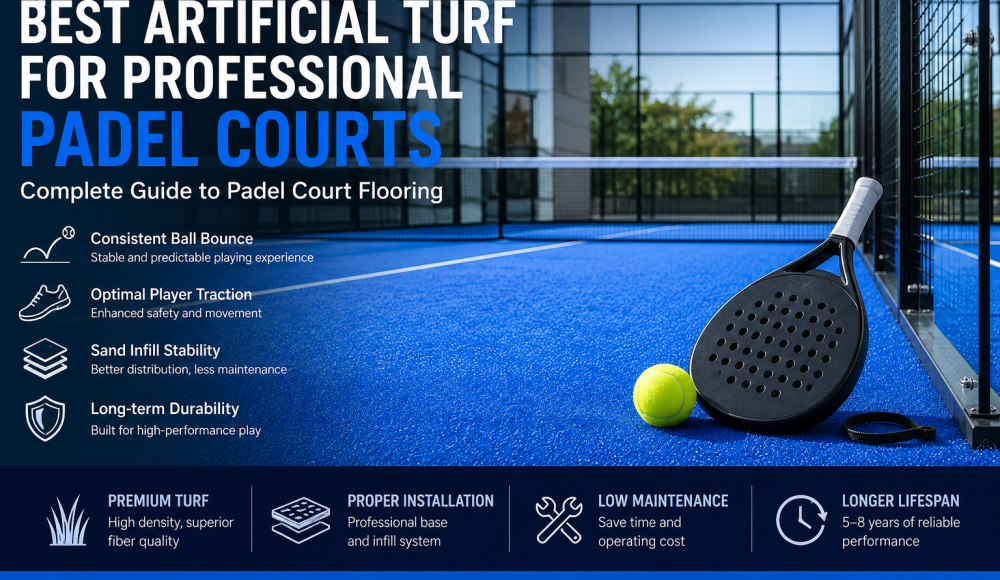
In professional padel court engineering, the turf is not just a surface layer. It directly determines:
- Ball bounce consistency
- Player traction and safety
- Sand infill stability
- Maintenance cost over time
- Overall court lifespan
So the real question is not simply which synthetic grass should be used, but:
How should a padel turf system be selected and installed to ensure long-term performance and durability?
What Is Padel Artificial Turf?
Padel artificial turf is a specialized synthetic grass system designed for padel court surfaces.
Unlike landscaping grass, it is engineered for:
- Controlled ball rebound behavior
- High-frequency sports movement
- Sand-filled stabilization system
- UV resistance for outdoor use
- Long-term wear resistance
A complete padel court flooring system includes:
- Concrete or steel base
- Leveling and drainage system
- Shock absorption layer
- Artificial turf with sand infill
Each layer affects final court performance.

Engineering Importance of Turf Quality
The quality of padel turf directly affects:
- Ball speed and rebound consistency
- Player movement safety
- Court surface stability
- Maintenance frequency
- Lifecycle cost of the court
In real club operation, differences between high-quality and low-quality turf become visible within months of usage.
Professional Specification (LDK Full Panoramic Padel Turf)
LDK full panoramic padel court artificial turf is designed for professional sports facilities with the following specification:
- Color: Blue
- Pile Height: 12mm
- Gauge: 3/16 inch
- Density: 63,000 stitches/m²
- Dtex: 9,000
- Backing: PP + mesh backing system
This specification is optimized for panoramic glass padel courts, clubs, and high-frequency sports environments.
Why These Specifications Matter
1. High Density (63,000 stitches/m²)
Higher density improves:
- Ball bounce stability
- Sand distribution consistency
- Resistance to fiber deformation
Compared with standard turf (50,000–58,000 stitches/m²), this system provides more stable long-term performance.
2. 12mm Pile Height
The 12mm height provides:
- Balanced ball speed
- Controlled player movement
- Professional match behavior
It is widely used in competitive padel court systems.
3. 3/16 Inch Gauge
A tighter gauge structure ensures:
- Stronger turf stability
- Better sand retention
- Longer service life
This is critical for high-usage club environments.
4. 9000Dtex Fiber Strength
High Dtex yarn provides:
- Stronger fiber resilience
- Reduced flattening
- Longer durability under heavy use
5. PP + Mesh Backing System
This backing system improves:
- Structural stability
- Drainage performance
- Fiber locking strength
It ensures consistent performance in outdoor environments.
Installation Quality Impact on Court Performance
Even premium turf will underperform if installation is not correct.
1. Proper Installation (Professional Standard)
- Flat and stable base
- Correct sand infill quantity
- Proper brushing process
- Controlled drainage design
Result:
- Stable ball bounce
- 5–8 year lifespan
- Low maintenance cost
- Professional playing experience
2. Low-Quality Turf System
- Low-density turf
- Weak fiber structure
- Poor backing system
Result:
- Uneven bounce
- Fiber flattening
- Short lifespan
- High maintenance cost
3. Installation Mistakes
Common issues:
- Uneven concrete base
- Incorrect sand amount
- Poor drainage design
Result:
- Water pooling
- Surface deformation
- Reduced usability
Textured Padel Turf vs Standard Turf
| Feature | LDK Professional Turf | Standard Turf |
| Density | 63,000 stitches/m² | 50,000–58,000 |
| Ball Bounce | Stable | Inconsistent |
| Durability | High | Medium/Low |
| Sand Retention | Excellent | Moderate |
| Maintenance | Lower | Higher |
| Club Suitability | Professional | Recreational |
Conclusion:
Textured / high-density padel turf is now the preferred solution for professional clubs and commercial sports centers.
Maintenance Impact of Turf Quality
High-Quality Turf System:
- Lower maintenance frequency
- Stable sand distribution
- Longer lifespan (5–8 years)
- Lower total lifecycle cost
Low-Quality Turf System:
- Frequent brushing required
- Faster fiber wear
- Higher maintenance cost
- Short replacement cycle
Application in Professional Padel Projects
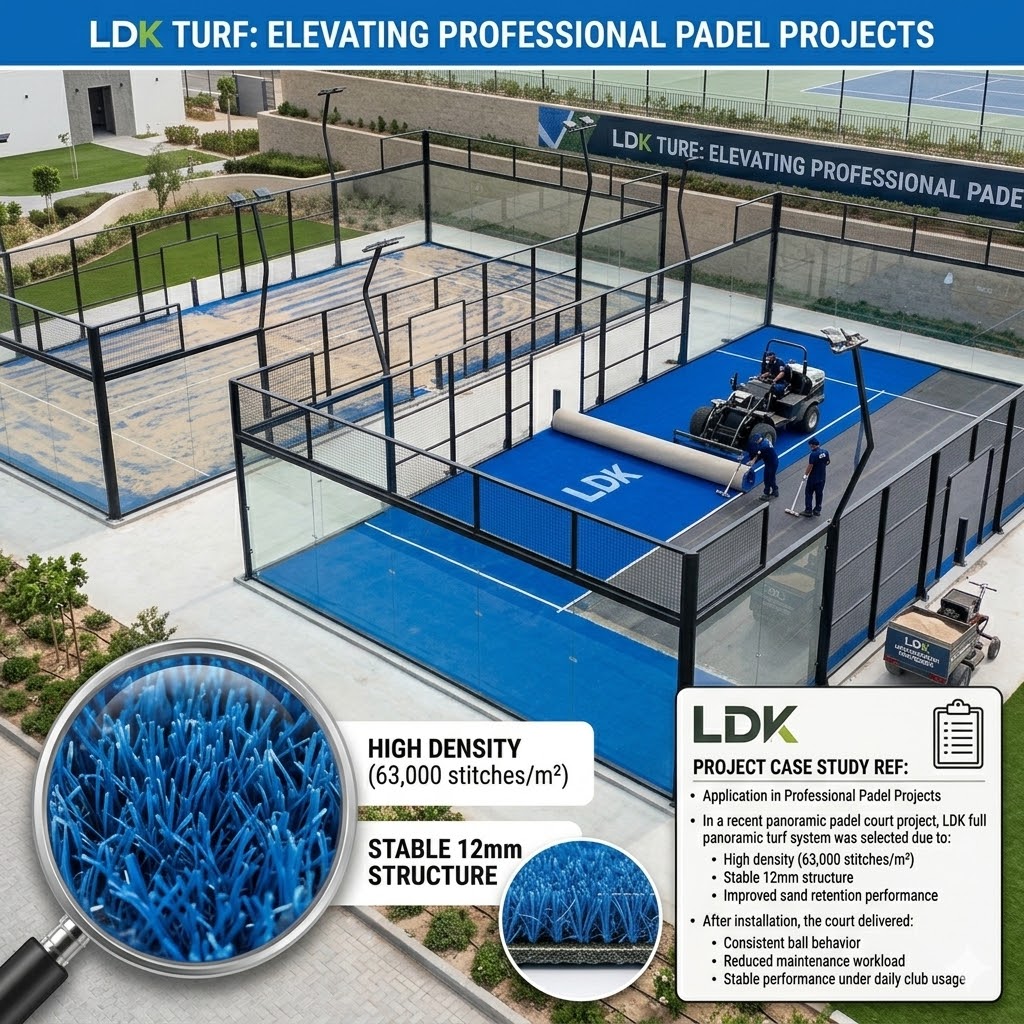
In a recent panoramic padel court project, LDK full panoramic turf system was selected due to:
- High density (63,000 stitches/m²)
- Stable 12mm structure
- Improved sand retention performance
After installation, the court delivered:
- Consistent ball behavior
- Reduced maintenance workload
- Stable performance under daily club usage
Recommended Specification Summary
For professional padel courts, the recommended turf system includes:
- Pile Height: 12mm
- Density: 58,000–63,000 stitches/m²
- Dtex: 8,000–9,000
- Gauge: 3/16 inch
- Backing: PP + mesh / PP + PU
- Color: Blue / Green
Conclusion
Selecting padel artificial turf is not just a material decision—it is a system engineering decision that affects performance, durability, and long-term operating cost.
A professional padel court requires:
- Proper turf specification
- Correct installation system
- Balanced maintenance strategy
High-quality synthetic grass for padel court systems ensures:
- Stable gameplay
- Longer lifespan
- Lower maintenance cost
- Better player experience
For clubs, schools, resorts, and commercial sports facilities, choosing the right padel court flooring system is critical for long-term success.
Contact Us
We provide complete padel court systems including:
- Artificial turf
- Court structure
- Sports flooring solutions
Contact us for professional padel court system design and quotation.