

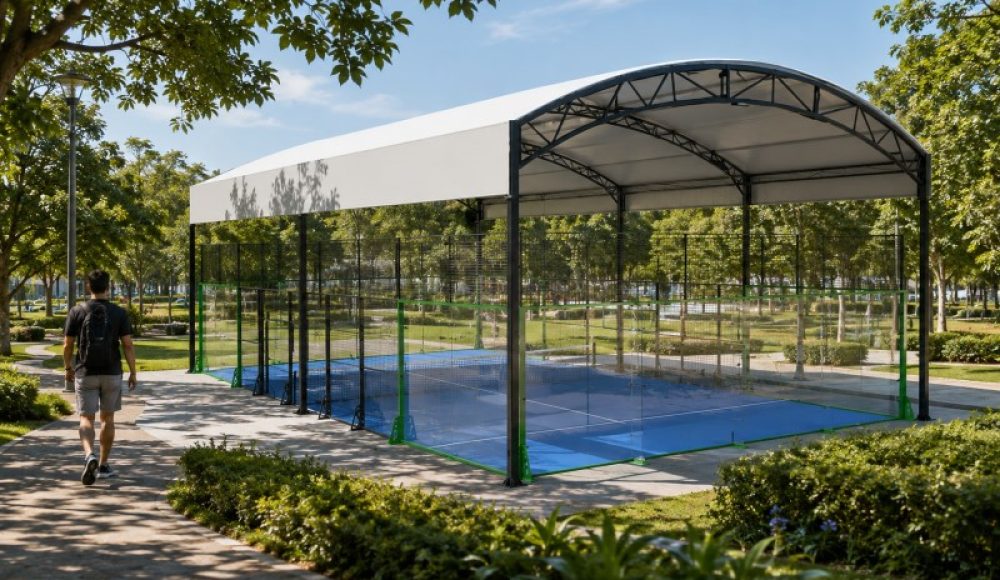
Sports facility developers, fitness club operators, and commercial project buyers often evaluate technical specifications before building a padel court. One common question is: What are the official dimensions for a WPT standard padel court, and should you choose 10mm or 12mm tempered glass?
A WPT standard padel court must meet specific dimensional and structural requirements to support safe play and consistent ball performance. Therefore, understanding the standards established by the International Padel Federation (FIP) helps buyers make informed investment decisions. In addition, glass thickness affects structural strength, impact resistance, ball rebound, and overall project cost.
This guide explains the official WPT and FIP court dimensions, compares 10mm and 12mm tempered glass, and outlines the key factors to consider when selecting materials for commercial padel court construction. Whether you are building a sports club, resort, or tournament venue, these insights will help you choose a reliable and compliant court system.
Choosing non-compliant padel court materials can affect safety, durability, and tournament eligibility. It may also cause incorrect ball bounce and increase the risk of glass panel damage. In contrast, high-quality structural materials improve court performance and reduce long-term maintenance costs. They also support a consistent playing experience for athletes and clubs. This guide explains official padel court dimensions, tempered glass specifications, and key material requirements. It also helps buyers select reliable components for new padel court projects.
1. Precise Dimensional Requirements: The Anatomy of a Sanctioned Court Enclosure
To guarantee tournament-grade playability, engineering teams must execute court assembly according to the precise spatial blueprints established by international governing bodies. A certified WPT standard padel court requires a perfectly rectangular playing field measuring exactly 20 meters in length by 10 meters in width, split down the center by a regulation padel net.
The court perimeter utilizes a secure, hybrid enclosure combining transparent structural glass walls and heavy-duty metallic mesh panels to allow for off-court play and spectator viewing. The back walls at both ends of the court must stand exactly 3 meters high from the playing surface, constructed entirely of impact-resistant glass. For the side walls, the first 2 meters extending from the back corners must consist of glass panels, while the remaining middle section utilizes metallic mesh panels that step down or transition smoothly in height to match regulation net anchorage zones.

2. Structural Glass Thickness Analysis: 10mm Standard vs. 12mm Professional Panels
Selecting the correct glass substrate dictates the structural safety of the facility during high-impact professional rallies. Players frequently crash into the walls at high speeds to save deep balls, choosing tempered glass thickness a vital safety and performance decision.
10mm Tempered Glass Panels
This specification represents the traditional baseline configuration for commercial clubs and private training centers. A 10mm tempered glass installation provides sufficient structural integrity for standard club play and amateur leagues. Choosing 10mm glass lowers initial structural shipping weight and material costs, helping club managers optimize their early-stage facility setup budgets.
12mm Tempered Glass Panels
For venues hosting official WPT events, professional tournaments, or televised sports broadcasts, specifying 12mm premium tempered glass is mandatory. The extra thickness increases the overall structural mass, which significantly stabilizes ball rebound consistency across the entire wall surface. Furthermore, 12mm glass panels absorb heavy player impacts much better, reduce structural frame shaking, and provide maximum resistance against catastrophic shattering during competitive professional matches.
Court Material Configuration Profiles
| Structural Component | Premium Tournament Specification | Standard Commercial Specification | Primary Engineering Benefit |
| Enclosure Framework | 12mm Tempered Panoramic Glass | 10mm Tempered Sectional Glass | Maximizes camera viewing angles and spectator sightlines |
| Side Wall Mesh | Anti-injury electro-welded mesh | Standard modular wire mesh | Prevents ball catching and protects players from abrasions |
| Playing Surface | Texturized monofilament turf | Standard fibrillated artificial grass | Delivers optimal shoe grip and predictable ball bounce physics |
3. Material Composition Mastery: Turf, Steel, and Enclosure Frameworks
Building a world-class court requires combining three premium structural elements to ensure the facility withstands years of heavy outdoor use:
- Panoramic Structural Glass Enclosures: Professional tournament venues utilize a seamless panoramic glass design that eliminates vertical steel support pillars along the back wall, providing unobstructed lines of sight for television broadcast crews and live spectators.
- Structural Metallic Mesh Enclosures: The side mesh must resist continuous ball impacts and outdoor rust. Specifying high-tensile structural steel mesh with a zinc-rich primer and electrostatic powder coating prevents corrosion and frame warping.
- Advanced Texturized Synthetic Turf: Selecting professional, texturized monofilament artificial grass filled with fine silica sand ensures excellent multidirectional traction, minimizes skeletal joint stress for players, and keeps the ball moving at a fast, tournament-approved pace.
Conclusion: Future-Proof Your Racket Sports Infrastructure
In conclusion, scaling a highly profitable commercial sports club, international resort attraction, or professional tournament stadium requires selecting court materials that strictly comply with WPT engineering guidelines.
Stop risking your development capital, structural warranties, and player safety on low-tier sectional frame kits that shake upon impact, warp under heavy wind loads, or provide inconsistent ball rebounds. Upgrading your venue layout to our certified WPT standard padel court configurations guarantees exceptional weather resilience, pristine glass clarity, and professional-grade performance across every match. We select every raw steel beam and stress-test every tempered glass panel to satisfy the highest international structural safety standards. Contact our sports facility engineering group today to submit your venue plot dimensions and receive a comprehensive, high-volume equipment quote.

