Why Choose a Mobile Padel Court for Eco Resorts?
Padel courts are becoming attractive amenities for resorts, beach clubs, and luxury hotels seeking to improve guest experiences and expand recreational offerings. However, permanent court installations can require substantial site preparation, concrete foundations, and long-term land commitments.
For eco-resorts and seasonal tourism destinations, these requirements can limit development flexibility and increase installation costs.
A mobile padel court for eco-resorts offers an alternative. With a modular steel foundation and removable structural components, a portable padel court can reduce the need for permanent ground alterations and allow relocation when property requirements change.
For hospitality operators, this approach combines recreational value with greater flexibility in site planning, seasonal operations, and asset management.
1. Reduce Permanent Site Alterations with a Mobile Padel Court
Eco-resorts often operate in environmentally sensitive landscapes where minimizing excavation and permanent construction is a priority. Traditional padel courts may require concrete foundations, extensive site preparation, and drainage modifications.
A mobile padel court with a modular steel foundation can reduce these requirements, depending on the site conditions and court design.
Modular Steel Foundation Design
A portable padel court uses a supporting steel structure to distribute loads across the prepared installation surface. Depending on the manufacturer’s specifications, the system may be suitable for selected paved areas, compacted ground, or other engineered supporting surfaces.
Before installation, buyers should evaluate:
- Ground bearing capacity and settlement risk
- Surface levelness and drainage
- Structural stability and anchoring requirements
- Glass panel support and connection details
- Local building and environmental regulations
Although a modular foundation may reduce the need for a permanent concrete slab, it does not eliminate all site preparation. The supporting surface must meet the structural requirements of the selected court.
Preserve Landscape Flexibility
By reducing permanent foundations and extensive excavation where feasible, mobile padel courts can help hospitality operators limit changes to existing landscapes.
This approach may be particularly useful for resorts that want to add recreational facilities to existing paved areas or temporary activity zones. Site-specific drainage and ground protection measures remain essential, especially in environmentally sensitive locations.
2. Adapt to Seasonal Operations and Severe Weather
Seasonal resorts often need to change how they use outdoor spaces throughout the year. A permanent padel court can limit those options, especially when a property closes during the off-season or repurposes land for other activities.
A portable padel court offers greater operational flexibility because its modular components can be dismantled and transported when the design and installation method permit.
Simplify Relocation and Off-Season Storage
A typical relocation plan may include:
- Inspecting the court and preparing a dismantling plan.
- Removing glass panels and other components according to the manufacturer’s procedures.
- Disassembling the steel structure and organizing hardware.
- Packing components for protected storage or transportation.
- Inspecting the new installation site before reassembly.
The time required depends on court design, crew size, lifting equipment, transport access, and site conditions. Buyers should request a manufacturer-approved dismantling procedure and a realistic relocation schedule before purchasing.
Plan for Storm Season
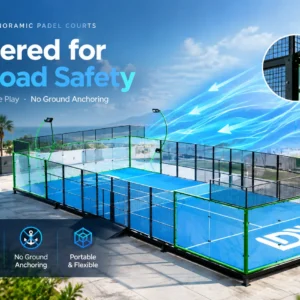
Coastal resorts and island destinations may face strong winds, tropical storms, or hurricanes. Large glass panels and steel structures require careful consideration of wind loads and anchoring.
A mobile court can provide an option for removing vulnerable components before severe weather arrives. However, disassembly does not automatically eliminate storm-related risks, and not every mobile court can be dismantled quickly.
Resort operators should confirm the court’s wind-load design, anchoring requirements, component handling procedures, and safe-storage arrangements. Decisions should follow local weather guidance and the manufacturer’s engineering instructions.
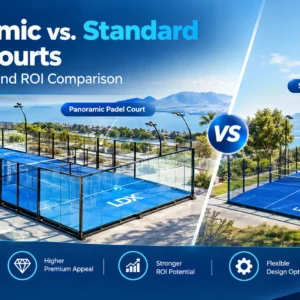
3. Mobile vs. Permanent Padel Courts: Key Differences
| Evaluation Factor | Permanent Padel Court | Mobile Padel Court |
|---|---|---|
| Foundation | Often uses permanent concrete foundations | Uses a modular supporting system, subject to site requirements |
| Site preparation | May require extensive excavation and construction | May reduce permanent ground alterations |
| Relocation | Usually difficult and costly | Designed to support dismantling and relocation |
| Seasonal flexibility | Court generally remains in place | Can potentially be stored or moved |
| Severe-weather planning | Depends on structural design and anchoring | May allow component removal where practical |
| Installation requirements | Requires suitable foundations and construction planning | Requires a suitable supporting surface and assembly planning |
| Multi-property use | Usually tied to one location | May be transferable between suitable properties |
| Initial investment | Depends on civil works and court specifications | Depends on modular design, transport, assembly, and foundation requirements |
The right choice depends on the property’s expected operating period, ground conditions, construction restrictions, weather exposure, and long-term investment plan.
4. Is a Mobile Padel Court Suitable for Your Resort?
Does a Mobile Padel Court Need a Level Surface?
Yes. A suitable, stable, and sufficiently level supporting surface is essential for safe play and structural alignment.
Some systems may offer adjustable leveling components, but these cannot compensate for every ground condition. The manufacturer should confirm allowable surface deviations, load-bearing requirements, drainage provisions, and anchoring methods before installation.
Can a Mobile Padel Court Reduce Environmental Impact?
It can reduce certain impacts associated with permanent construction, particularly when the design avoids extensive excavation and concrete foundations. However, transportation, ground preparation, materials, drainage, and installation activities still have environmental implications.
For eco-resorts, a site assessment should identify the least disruptive installation method that meets structural and safety requirements.
Can Hotels Relocate a Mobile Padel Court to Another Property?
Potentially, yes. A modular court can be dismantled and reinstalled at another suitable location if its components, transport arrangements, and foundation design support relocation.
Before treating the court as a transferable asset, hospitality groups should assess transportation costs, storage requirements, reinstallation expenses, component lifespan, and compatibility with the destination site.
Tax depreciation and asset classification vary by jurisdiction, so buyers should consult local accounting and tax professionals rather than assume that every mobile court qualifies for a particular tax treatment.

Conclusion: A Flexible Padel Court Solution for Seasonal Hospitality
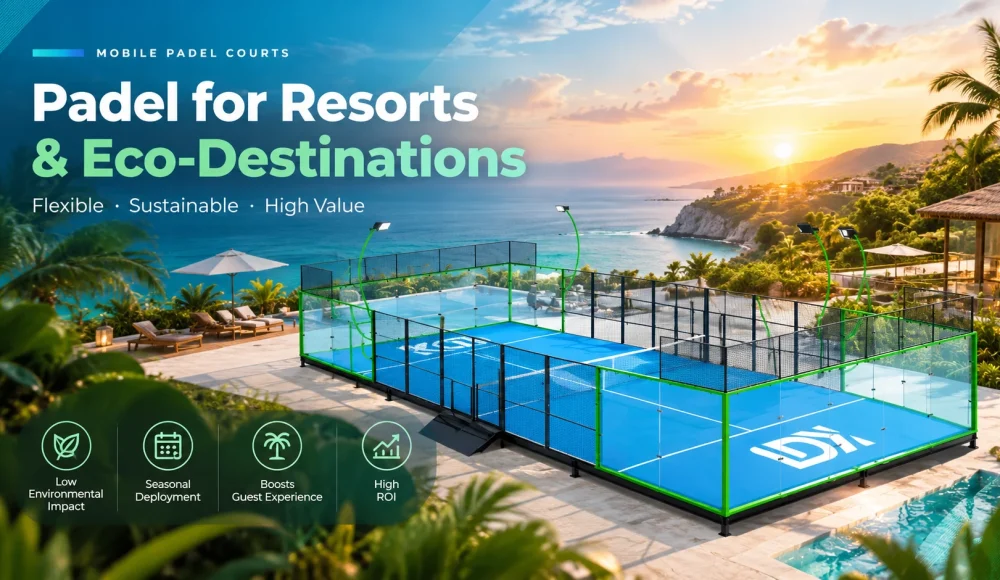
A mobile padel court for eco resorts offers hospitality operators an alternative to permanently installed sports facilities. Its modular steel foundation and relocatable structure can reduce permanent site alterations, support seasonal space planning, and provide options for moving or storing the court when necessary.
For eco-resorts, beach clubs, and seasonal destinations, the key is to match the court design to the ground conditions, environmental requirements, and operational schedule.
Explore LDK Portable Padel Court Solutions
Planning to add padel facilities to a resort, hotel, or beach club? Explore the LDK Portable Panoramic Mobile Padel Court with Steel Foundation.
Contact LDK to discuss foundation options, installation requirements, structural specifications, and project quotations for your hospitality venue.