Can a Portable Padel Court Stay Stable Without Ground Anchors?
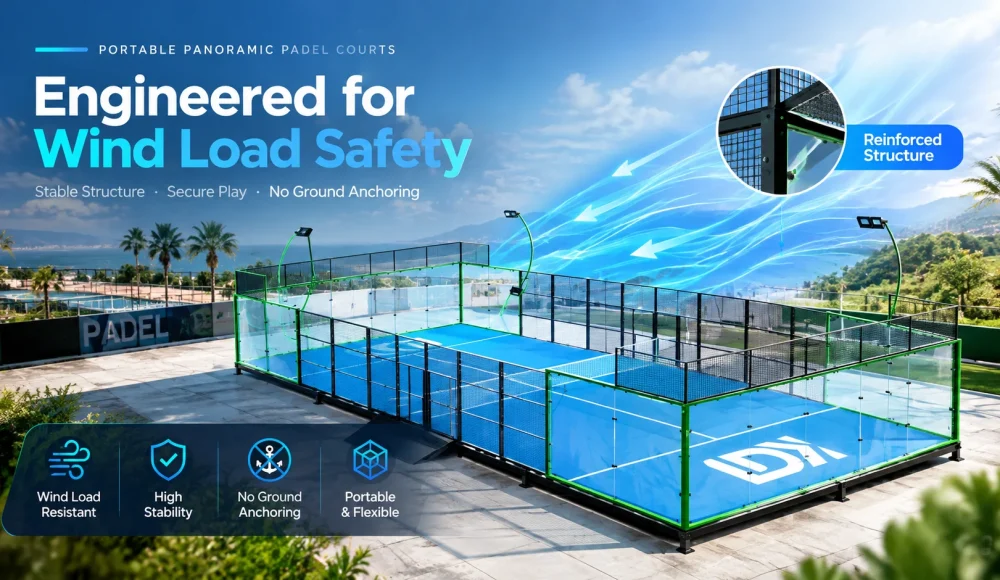
A portable panoramic padel court with steel foundation offers a flexible solution for resorts, sports clubs, exhibition venues, rooftops, and temporary sporting events. Its modular structure allows operators to install and relocate a court without necessarily drilling permanent anchors into an existing concrete surface.
However, removing conventional ground anchors creates an important engineering challenge: how can the court resist wind pressure, horizontal sliding, and overturning?
The answer lies in a combination of structural design, foundation geometry, dead weight, ground friction, and site-specific wind calculations. Steel columns support the enclosure, tempered glass panels transfer lateral loads, and the integrated steel foundation connects the structure into a unified system.
For buyers evaluating a non-anchored portable padel court, understanding these factors is essential for selecting a suitable solution and planning a safe installation.
1. How Wind Loads Affect a Portable Panoramic Padel Court
A standard padel court measures approximately 20 × 10 m. Its glass walls, steel framework, and mesh panels create surfaces that interact with wind from different directions.
When wind strikes the enclosure, it generates pressure and suction. These forces transfer through the glass supports, steel columns, structural connections, and foundation chassis before reaching the supporting ground.
Three major risks require evaluation:
- Overturning: Wind forces create a moment that may rotate the court around an edge of its foundation.
- Sliding: Horizontal wind forces may exceed the available friction between the foundation and the supporting surface.
- Structural deformation: Steel columns, glass supports, and connecting components may experience excessive stress or displacement.
A reliable design must address all three risks. Increasing the court’s weight alone does not guarantee adequate wind resistance.
2. Three Structural Elements That Support Court Stability
1. Steel Columns and Perimeter Framework
Steel columns support the enclosure and transfer wind loads toward the foundation. For example, a design may use 100 × 100 × 3 mm square steel tubing, depending on the structural requirements.
The performance of these columns depends on more than their external dimensions. Engineers must evaluate steel grade, unsupported length, connection details, section properties, and the calculated wind loads.
A properly designed steel framework helps control deflection and maintain the alignment of the glass panels.
2. 12 mm Tempered Glass Panels
Tempered glass provides visibility and impact resistance for the panoramic enclosure. A 12 mm glass panel typically weighs approximately 30 kg/m², making glass weight a relevant part of the court’s overall dead load.
However, glass weight should not be treated as the primary wind-resistance mechanism. Engineers must assess the panel dimensions, support configuration, edge conditions, fixing hardware, and applicable safety requirements.
The design must also account for wind pressure transferred from the glass to the steel frame and foundation.
3. Integrated Steel Foundation Chassis
The steel foundation connects the structural supports and distributes loads across the court’s base.
For a portable court, this integrated chassis can provide several advantages:
- Connects individual structural sections into a coordinated assembly.
- Distributes local forces through the foundation framework.
- Provides a defined interface with the supporting surface.
- Allows the structure to be assembled and disassembled for relocation.
Nevertheless, the chassis must be engineered for the actual installation conditions. Its footprint, mass, connections, and contact with the ground all affect stability.
3. How Does a Non-Anchored Padel Court Resist Wind?
The stability of a portable panoramic padel court depends on three related engineering checks.
Overturning Resistance
Wind pressure creates an overturning moment around the edge of the foundation. The court’s weight and its distribution generate a resisting moment.
Engineers compare these effects using the applicable structural design method, accounting for wind direction, pressure distribution, load combinations, and safety requirements.
A wider foundation footprint may improve overturning resistance by increasing the effective lever arm. However, the final result depends on the complete structural configuration.
Sliding Resistance
A simplified model expresses frictional resistance as:
[ F_f = \mu N ]
Where:
- (F_f) is the available frictional resistance.
- (\mu) is the coefficient of friction between the base interface and supporting surface.
- (N) is the effective normal force.
The available resistance depends on the actual interface materials and site conditions. Rubber pads may improve grip on suitable surfaces, but their performance must be verified for the specified substrate.
Dust, water, surface coatings, uneven paving, and other conditions can change friction. Additional checks may also be necessary for uplift and uneven load distribution.
Structural Strength and Deflection
Even if a court does not slide or overturn, its components must withstand the calculated loads.
Engineers should check the steel members, glass panels, fasteners, welds, base connections, and foundation chassis. Excessive deformation can affect both structural safety and glass integrity.
Important: A court’s wind rating must come from engineering calculations, testing, or other appropriate verification for the specific configuration. It should not be inferred from steel dimensions or total weight alone.
4. Portable vs. Permanently Anchored Padel Courts
| Engineering Factor | Permanently Anchored Court | Portable Court with Steel Foundation |
|---|---|---|
| Ground connection | Mechanical or chemical anchors, as designed | Integrated base relying on its engineered support and restraint system |
| Installation | Requires suitable substrate and anchoring details | Can reduce permanent ground modifications when site conditions permit |
| Relocation | Generally more involved | Modular construction can simplify relocation |
| Wind resistance | Depends on anchors, substrate, and frame design | Depends on dead weight, footprint, friction, and verified restraint measures |
| Site preparation | Often includes anchor installation | Requires a suitable, stable, and sufficiently level supporting surface |
| Main procurement concern | Anchor capacity and substrate integrity | Verified stability under the intended site and wind conditions |
Neither approach is universally safer. The appropriate choice depends on site restrictions, local wind exposure, foundation conditions, and the court’s verified design.
5. How Can Buyers Improve Portable Court Stability?
For temporary installations, especially in exposed outdoor locations, buyers should discuss the following measures with the manufacturer.
Engineered ballast provisions: Purpose-designed ballast compartments or counterweights can increase resisting weight when included in the structural calculations.
Foundation footprint optimization: A wider base or engineered extensions may increase the resisting moment arm. These additions must be designed to avoid creating new connection or trip hazards.
Suitable base interfaces: Specify appropriate pads or contact materials for the actual surface. Confirm performance under expected dry and wet conditions.
Site-specific wind assessment: Consider local wind speeds, surrounding buildings, rooftop exposure, terrain, and possible channeling effects between structures.
Severe-weather procedures: Establish operating restrictions and closure procedures based on the court’s verified wind rating. Do not remove mesh panels, alter structural components, or add improvised ballast unless the manufacturer has approved the procedure.
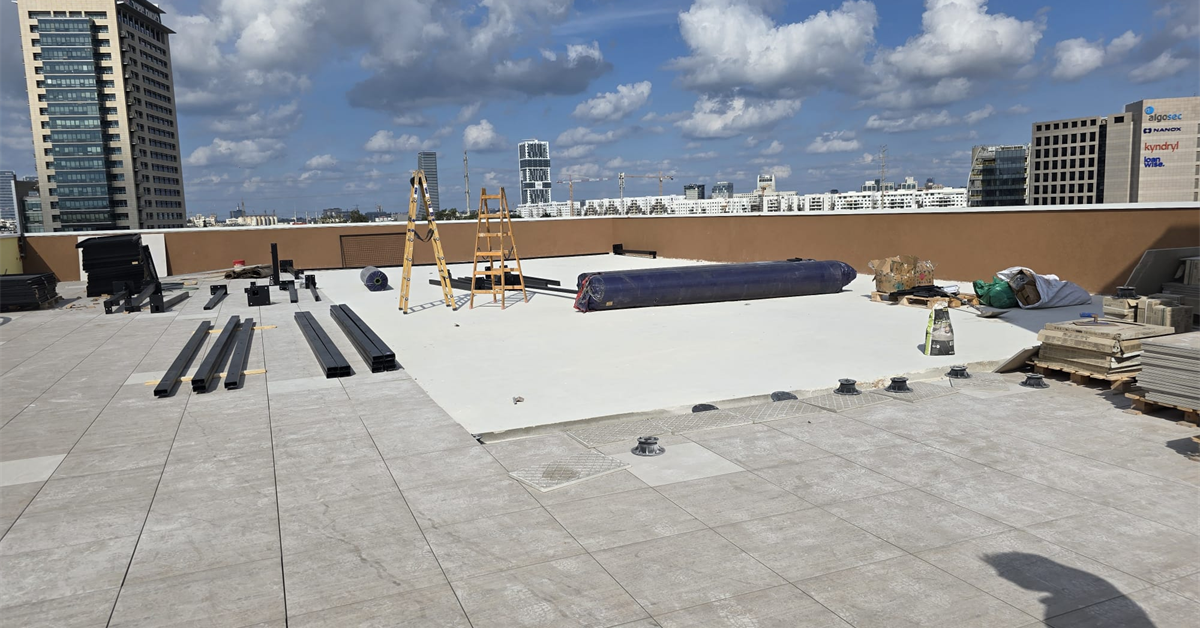
For rooftop installations, buyers should also verify the supporting structure’s capacity for the court’s dead load, live load, and wind-related forces.
6. Frequently Asked Questions
Can a portable panoramic padel court operate without ground anchors?
Some portable courts can be designed to operate without conventional ground anchors under specified conditions. However, suitability depends on the foundation design, ballast, supporting surface, wind exposure, and verified stability calculations.
What steel column size should a portable padel court use?
A design may use 100 × 100 × 3 mm steel columns, but no single section size suits every project. Engineers must verify member strength, deflection, connections, and the applicable structural requirements.
Do 12 mm tempered glass panels improve wind stability?
The glass contributes to the enclosure’s dead load and transfers wind pressure through its supports. However, its primary function is not to act as ballast. Panel strength, fixing details, and the supporting structure must all be assessed.
What wind speed can a portable padel court withstand?
The allowable wind speed depends on the specific court design, installation configuration, site exposure, and engineering verification. Buyers should request the manufacturer’s documented wind calculations and any applicable test reports instead of relying on a generic wind-speed figure.
Can a portable padel court be installed on a rooftop or temporary event surface?
Potentially, provided the surface is suitable and the installation meets structural and safety requirements. Rooftop projects require additional assessment of the supporting building structure, wind exposure, load distribution, and applicable regulations.
Conclusion: Choose an Engineered Portable Padel Court Foundation
A portable panoramic padel court with steel foundation can offer flexibility for temporary venues and projects where permanent ground anchoring is undesirable or restricted.
Its stability depends on the combined performance of the steel framework, glass supports, integrated foundation chassis, dead weight, ground interface, and site-specific wind design. A complete engineering assessment is essential before installing the court in an exposed location.
For sports facility operators and project developers, the best purchasing decision balances portability, installation requirements, structural performance, and documented safety verification.
Explore LDK Portable Panoramic Padel Court Solutions
Planning a temporary sports venue, resort installation, or relocatable padel facility? Explore the LDK Portable Panoramic Padel Court with Steel Foundation.
Contact LDK to discuss court configurations, foundation specifications, installation conditions, and available structural documentation for your project.