Contents
- What does a padel court investment actually include?
- Which line items belong in a complete padel court budget?
- How do court type, cover, and site conditions change the quote?
- How should you localize landed costs across the Middle East, Europe, and the Americas?
- How can buyers compare supplier quotes and turnkey scope fairly?
- How do you test revenue, running costs, and payback assumptions?
- What should each buyer verify before committing capital?
- Frequently asked questions (FAQ)
- Conclusion: Closing checklist
For the query “padel court investing cost,” the starting point is scope: a court-kit price is not the same as the full project budget. The full project can include the court system, site preparation, foundations and drainage, freight and import charges, installation, local approvals, venue fit-out, opening cash, and future maintenance reserves. Until those scopes are clear, two supplier quotes may describe very different projects.
The practical way to budget is to price each responsibility separately, then test the operating assumptions that must repay the investment. The guide below gives you a cost checklist for the Middle East, Europe, and the Americas, plus a method for comparing quotes without assuming one universal price or return.
What does a padel court investment actually include?
Start by asking what the word “court” means on a quote. A supplier may price the manufactured enclosure and playing system; an installer may price a completed court on a prepared base; an investor needs the cost of an operating venue. Those are three different scopes.
| Budget scope | May include | Still to verify |
|---|---|---|
| Court package | Frame, enclosure, glass, turf, net, and listed lighting options | Packing, freight, taxes, unloading, foundation, installation, commissioning, and warranty exclusions |
| Installed court | Court package plus some groundworks, base, assembly, and testing | Site surveys, utilities, permits, roofs, professional fees, venue areas, opening costs, and working capital |
| Full venue investment | Installed court or courts plus the wider facility and launch plan | Land or lease, building/HVAC, access and parking, staffing, operating cash, lifecycle reserves, and financing/tax treatment |
Treat these as comparison labels, not standard industry definitions. Ask every bidder for a written inclusions-and-exclusions schedule. A court quote becomes useful only when you can compare it with the same drawing, site assumptions, delivery point, specification, and contract boundary.
For context, the Lawn Tennis Association’s 2025 UK construction guidance gives a dated one-court illustration: £36,000 for a court with lights and £35,000 for ring beam, base, ducting, and drainage, or £71,000 total before VAT and fees. The guide says location and site conditions affect the final cost. This is a scoped UK example, not a global price, current market average, or supplier quote. See the LTA construction guidance.
Which line items belong in a complete padel court budget?
Build the budget from the ground up. For each line, name the party expected to quote it and whether it is a one-time capital cost, a pre-opening expense, or an ongoing cost.
| Cost line | Typical quote owner | Questions to ask | Timing |
|---|---|---|---|
| Court system | Manufacturer or distributor | Which frame, glass, turf, net, lighting, finish, and documentation are included? | Capital |
| Survey, design, and engineering | Local surveyor or engineer | Are ground conditions, wind, drainage, structure, access, and cover included in the design? | Pre-construction |
| Site preparation and foundation | Civil contractor | Who handles excavation, soil treatment, slab or ring beam, levels, drainage, and utilities? | Capital |
| Freight and delivery | Supplier, forwarder, or importer | What is the named delivery point? Who pays insurance, port charges, duties, tax, unloading, and last-mile delivery? | Capital |
| Installation and commissioning | Supplier or local installer | Who assembles, connects, inspects, tests, and hands over the system? | Capital |
| Roof, building, or indoor services | Structural/building contractor | Are structure, foundations, lighting, ventilation/cooling, fire and building review, and drainage covered? | Capital and operating |
| Approvals and professional fees | Owner with local advisers | Which application, survey, review, or inspection is required for this site? | Pre-construction |
| Venue opening and operations | Owner/operator | What reception, access, booking, staffing, cleaning, insurance, and launch costs are needed? | Pre-opening and recurring |
| Working capital and reserve | Owner/finance team | How will rent, payroll, utilities, marketing, repairs, and replacement be covered during ramp-up? | Opening and recurring |
Keep contingency visible as a separate allowance rather than hiding it inside a supplier line. Its amount should follow the project’s design maturity and site uncertainty, not a generic percentage copied from an unrelated market. A lease deposit, pre-opening payroll, professional advice, or temporary access work may be payable before the venue earns revenue, so timing matters as much as the final total.
Before adding the lines, make a quote register with one row per deliverable, a named owner, a source document, a currency, a validity date, and a status such as quoted, estimated, or unpriced. This makes missing scope visible and helps prevent double-counting—for example, when both a turnkey bidder and a civil contractor include the same drainage work. Record payment milestones and any deposit separately from the total contract value because they affect cash needed before opening. Show recoverable and non-recoverable taxes separately only after a local adviser confirms the treatment for the owner and project. If the purchase currency differs from the venue’s revenue currency, model a reasonable exchange-rate sensitivity rather than silently converting every quote at today’s rate. Keep financing costs and land acquisition outside the construction subtotal, then show them as separate project-level assumptions so readers can see which comparison they are making.
Also separate lifecycle reserves from routine maintenance. The LTA’s 2025 UK guide recommends a £1,500 annual sinking fund per court for surface, lamp, and column replacement, with additional reserves considered for the structure, glass, or canopy. It is a UK planning example, not a universal maintenance allowance. Use the equipment manuals, local labor and parts costs, and expected operating intensity to build your own reserve.
How do court type, cover, and site conditions change the quote?
Choose a format only after checking the site and operating plan. Outdoor courts can avoid the cost of a full building but still need engineered foundations, drainage, access, and lighting. A canopy can reduce some weather exposure while adding structure, foundations, drainage, clear-height, and planning questions. An indoor venue may add rent or building costs, utilities, and cooling or ventilation needs. The right comparison is total project and operating cost against the hours you can realistically sell.
The FIP Rules of Padel specify a 20 m by 10 m internal playing area. They also state a 6 m minimum clear height and suggest 8 m for new facilities. Those dimensions help test a layout; they do not describe the full site area, circulation, access, columns, amenities, or local building requirements. Confirm drawings and site constraints with qualified local professionals. Consult the FIP rules.
Use this comparison before asking for a price:
| Format decision | Cost variables to check | Evidence to request |
|---|---|---|
| Outdoor | Ground, wind, drainage, corrosion environment, neighboring properties, lighting, and access | Site-specific foundation and drainage design; component and lighting specification |
| Covered | Canopy foundations, clear height, columns, roof drainage, planning, and maintenance | Structural drawings, foundation split, drainage plan, lighting layout, and approval scope |
| Indoor | Building or lease, clear span, floor and drainage, utilities, ventilation/cooling, and fire/building requirements | Measured layout, engineer review, utility estimate, and local approval checklist |
| Panoramic or other enclosure configuration | Glass, frame, support, finish, replacement access, and project specification | Drawings, glass and steel specifications, relevant documents, warranty, and spare-parts terms |
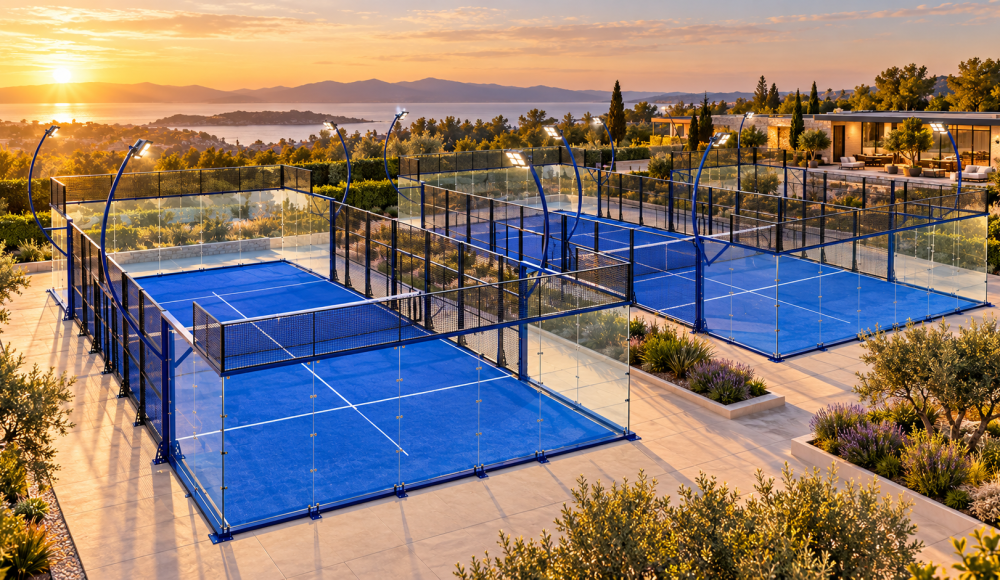
Panoramic appearance alone does not establish durability, safety, code compliance, or better economics. Compare the written specification and the documents that apply to your project. A 12 mm glass listing may be a product specification or a requirement in a particular jurisdiction; do not treat it as a universal FIP mandate. The LTA guidance provides a UK-specific reference. LDK’s panoramic glass padel-court page lists 12 mm tempered safety glass for this model; confirm the current drawing and glass submittal against the site specification and local requirements.
Before comparing LED package prices, request the fixture schedule and a site-specific photometric plan. Fixture count or wattage alone does not establish lux, uniformity, glare control, or local compliance.
The LTA guide’s 2025 UK canopy illustration totals £95,000 for one court—£20,000 for foundation and drainage plus £75,000 for canopy with a 3 m rain screen. It is a separate UK example; do not add it to the £71,000 court illustration without matching the scopes.
How should you localize landed costs across the Middle East, Europe, and the Americas?
Use a regional checklist rather than copying a price adjustment from another country. A landed budget depends on the delivery route, named place, currency, tax treatment, site labor, and local project requirements. Ask a local customs or tax adviser to confirm the applicable process before comparing totals.
Separate four questions in your model: what it takes to make the site usable, what it costs to bring and install the equipment, what the venue costs to operate, and which local charges or approvals apply. Ask the supplier to quote to a named delivery point and identify the party responsible for each handoff after arrival. Then collect local civil, electrical, and engineering inputs against the same site plan. That sequence helps expose a low equipment price that leaves major local work unpriced without guessing what those items should cost.
| Market scope | Questions that can change the budget | Local input to obtain |
|---|---|---|
| Middle East | Heat and coastal exposure; indoor cooling; commercial rent; delivery route; local VAT/customs; planning and municipality process | Site-specific engineering review, written import/tax advice, and authority/landlord checklist. Available community evidence is concentrated in Dubai/UAE; confirm Saudi and other country requirements locally. |
| Europe | Outdoor weather and drainage; cover or building needs; freight and installation; country-specific tax/customs and planning | Local contractor quotes, country-specific tax/import advice, planning confirmation, and applicable technical specification |
| Americas | Country/state variation; freight and port handling; foundation and climate design; labor; noise, access, and approvals | Local civil/structural quotes, permit and tax advice, delivery terms, and utility/site review |
For every market, record the currency, quote validity date, delivery term and named place, insurance, unloading, installation, taxes and duties, and exclusions. Keep exchange-rate exposure visible if costs and revenue use different currencies. For a public or school project, include procurement, accessibility, safeguarding, community-use scheduling, and lifecycle-cost requirements in the brief; the applicable rules depend on the owner and location.
In hot or coastal locations, ask a qualified designer to assess the actual site exposure and specify suitable materials, drainage, ventilation, and any cooling needs; do not assume one regional package fits every plot. For indoor proposals, request the building and utility assumptions used to estimate ongoing energy costs. For outdoor proposals, confirm who is responsible for weather-related design inputs and maintenance guidance. Treat these as scope questions for the design team, not as a substitute for local engineering or authority review.
How can buyers compare supplier quotes and turnkey scope fairly?
Send each supplier the same site information and specification. Ask for a line-by-line response instead of accepting “complete court” or “turnkey” as a complete scope definition. A priced specification is a useful way to compare bids against the same requirements, subject to any local procurement rules.
| Responsibility | Confirm in writing |
|---|---|
| Manufacturer | Equipment specification, packing, drawings, manuals, documents, warranty, parts, and production lead time |
| Distributor/importer | Import route, local stock, duties/tax handling, last-mile delivery, and regional support |
| Civil contractor | Survey assumptions, ground preparation, foundation, drainage, access, and reinstatement |
| Electrical contractor | Power connection, installation, testing, and lighting documentation |
| Engineer/consultant | Site-specific design, local review, technical sign-off, and professional responsibility |
| Venue owner/operator | Land or lease rights, applications, utilities, insurance, operating plan, and opening cash |
Compare steel and glass specification, turf type, lighting design, relevant certificates, foundation scope, transport, installation, testing, commissioning, warranty exclusions, spare parts, manuals, and after-sales responsibilities. Ask what happens if the delivered dimensions or site conditions differ from the quotation. A direct manufacturer quote may simplify specification discussions, while a local supplier may bundle installation or service; the route label does not tell you which has the lower landed cost.
Agree the handover evidence before signing: what inspection or commissioning records will be delivered, who records open defects, and when the warranty period begins. Ask which parts are stocked or ordered on demand, how replacement parts are identified, and whether routine maintenance instructions are provided. These answers do not make one bidder automatically better, but they let you compare the support obligations and the time or cost exposure the owner may retain after opening.
For custom or private-label projects, compare customization scope, drawings, branding, minimum order, lead time, documentation, and change-control terms. For any manufacturer, ask for the exact deliverables in the quotation rather than assuming every requested option is available. LDK lists OEM/ODM options on its product page, and its About page identifies the company as a manufacturer, so buyers can request a manufacturer-direct quotation. Ask the quotation to define customization, documents, delivery, local work, and support; direct sourcing alone does not prove the lowest landed cost.
Ask for a schedule showing what “turnkey” includes and excludes: permits, civil work, local engineering, electrical connection, tax/duty, unloading, assembly, commissioning, and post-handover support. Request comparable references and project documents where available. If an item is not explicitly assigned, assume it remains unresolved in your budget until the contract says otherwise. LDK describes turnkey project support and a professional service team across consultation, design, production, installation support, and after-sales (product page; services); have the contract identify whether permits, civil works, utilities, local sign-off, and commissioning are included.
A lighting package should come with a project-specific photometric plan; fixture count or wattage by itself does not establish lux, uniformity, glare control, or local compliance. LDK’s product page lists an optional eight-by-200 W LED package for the audited court model; use it as a quote specification to check against a site-specific photometric plan, not as evidence of illuminance or compliance.
How do you test revenue, running costs, and payback assumptions?
Build the operating model with local inputs, then test what happens when demand or cost moves against you. The basic court-hire formula is:
Annual court-hire revenue = number of courts × available court-hours per court per year × realized occupancy × average realized price per booked hour.
Use bookable hours, not every hour on the calendar. Separate peak from off-peak periods, closures, maintenance downtime, and ramp-up after opening. Add coaching, events, memberships, or food and beverage as separate lines only when you have a local operating plan and evidence for them; do not count the same customer spend twice.
For this model, realized occupancy means paid booked court-hours divided by the court-hours actually made available for booking over the same period. Write down how you treat complimentary sessions, cancellations, promotions, and downtime so that the rate and realized price use consistent definitions. If the booking system has no operating history yet, label the inputs as assumptions and use local competitor observation, customer research, or a phased launch to test them rather than presenting the spreadsheet as a forecast.
List recurring costs individually: rent, payroll, utilities, booking and access systems, cleaning, insurance, marketing, routine maintenance, replacement parts, and lifecycle reserves. Then calculate the cash available for capital recovery after those costs. If you show simplified payback, divide the upfront project investment by annual operating cash available for capital recovery and state what the calculation excludes, such as tax, financing, depreciation, or major refurbishment. It is a planning ratio, not a guaranteed return.
Create conservative, base, and upside cases by changing assumptions you can explain: court-hours sold, realized price, ramp-up period, rent, energy, staffing, and initial cost. If the project works only when every court is busy at peak prices, the model has not tested the downside. The LTA’s UK guide estimates lighting at about £1 per hour per court depending on configuration and recommends the reserve described above; use these only as UK reference points, then obtain local energy and maintenance inputs. Do not transfer a UK figure to another market without checking the configuration and prices.
What should each buyer verify before committing capital?
Before signing, combine the supplier schedule with a site and operating review. Confirm site control and lease duration; measured dimensions and clear height; ground, drainage, utilities, access, and noise; local applications and professional sign-off; delivery terms and taxes; commissioning and manuals; maintenance parts; opening cash; and a lower-demand scenario. A cost plan is stronger when every line has a named owner, a written basis, and a date.
Different buyers should add different checks. Investors should test the downside case and the lease term against the capital recovery period. Operators should validate hourly demand, staffing, programming, maintenance, and off-peak pricing. Distributors should compare specification parity, import responsibilities, installation partners, documentation, and parts support. Municipalities should include transparent procurement, accessibility, lifecycle cost, and public access. Schools should add safeguarding, timetable, access, and shared-use arrangements. Local advisers should confirm the rules for the specific jurisdiction. LDK lists its panoramic model for sports-club and school applications; buyers should still verify site fit, safeguarding and access needs, and applicable procurement requirements.
Use a short troubleshooting path if the project does not reconcile: a quote far below the budget may omit civil work or delivery—verify inclusions and rebuild the comparison; a covered layout that does not fit needs measured drawings and engineering review—revise it before ordering; a model that works only at peak hours needs local booking evidence and a downside case—phase the investment or change the operating plan before committing.
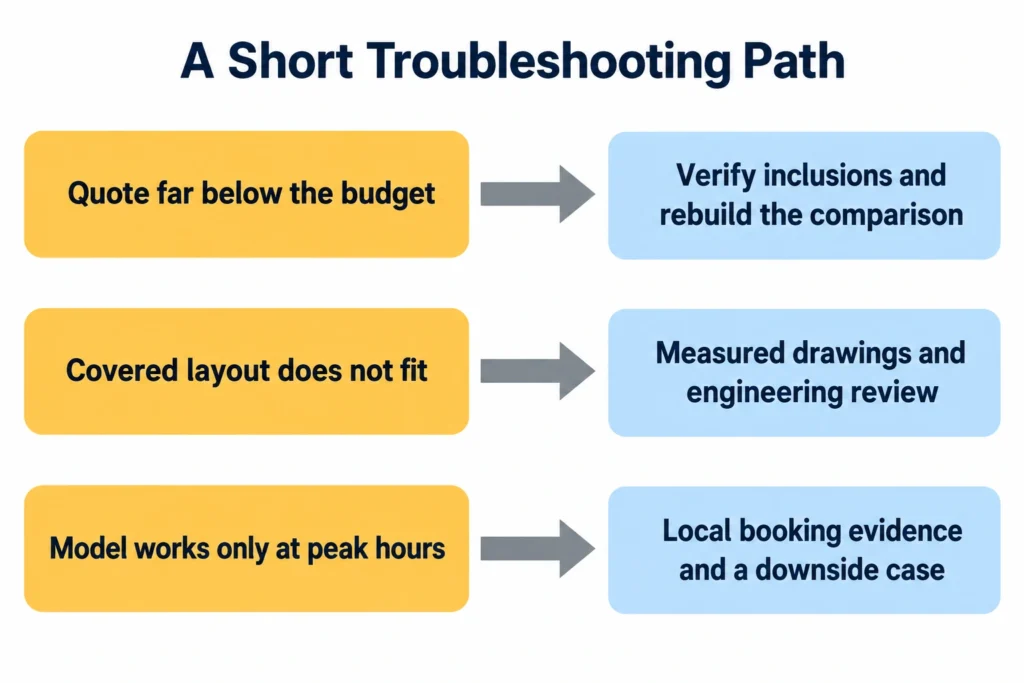
Three investment warning signs and the next checks in the article.
Frequently asked questions (FAQ)
Are cheap padel courts from China or Mexico actually worth it?
The country of manufacture does not settle value. Compare the delivered specification, documents, foundation and installation split, warranty, spare parts, and local support on a landed-cost basis. A lower package quote is not like-for-like until those items are priced. Use the supplier-comparison checklist above to normalize the bids.Padel club owners: what would you NEVER spend money on again?
There is no universal amenity to remove. Test each addition against local demand, staffing, maintenance, and the venue’s operating plan; use owner anecdotes to generate questions, not to forecast your own result. The buyer checklist and operating-cost section give a framework for that test.What do players value most at padel clubs?
Ask local players and test the answers in your catchment. Court condition, lighting, weather protection, and social space are useful topics to investigate, but this guide does not rank them for every market. Start with the site-format checks above, then validate the priorities with local users.Indoor vs Outdoor — what does the future look like?
Neither format wins everywhere. Compare site and climate needs with building or canopy cost, rent, approvals, sellable hours, and operating expense before choosing. The format and regional checklists above identify the inputs to collect.Why do padel clubs leave money on the table with rigid pricing?
Review actual booking patterns by hour before changing rates. Model peak and off-peak demand separately, then test whether a price change could fill otherwise unused hours without weakening the economics of existing bookings. Use the operating-model section to keep occupancy, realized price, and available hours consistent.Direct with manufacturers or through suppliers?
Compare the full delivered scope, local installation responsibility, documents, warranty, parts, and after-sales support. A manufacturer-direct quote is one sourcing route, not proof of the lowest total project cost. The quote-normalization checklist above applies to either route.
Conclusion: Closing checklist
Before requesting a final quote, send bidders the same site plan, format, specification, delivery point, and responsibility schedule. Add local civil, tax/import, approval, and operating inputs to the budget; then test a conservative demand case. The result is a project estimate that can be challenged and updated as the site becomes more certain.