Are you planning to build a single padel court but not sure which court type to choose, where to buy it, or how to turn the initial design into a real construction project?
For schools, hotels, sports clubs, residential communities and first-time padel investors, a single padel court can be a practical way to start with manageable space requirements and investment.
However, choosing the court itself is only one part of the project.
A complete single padel court solution should consider the site, court type, foundation, drainage, turf, lighting, shipping and local installation before production begins.
This guide explains how to choose the right single court, how to evaluate a padel court supplier, and how to turn an initial idea into a practical and buildable project.
1. Is a Single Padel Court the Right Solution for Your Project?
A single padel court is especially suitable when the available space, project budget or expected player volume does not yet justify a multi-court facility.
Typical applications include:
- Schools and universities
- Hotels and resorts
- Residential communities
- Private sports clubs
- Fitness centers
- Community recreation projects
- Small commercial sports facilities
- First-stage padel investment projects
For some investors, starting with one court is also a practical way to test local demand before expanding to two, four or more courts.
You can first review the different padel court systems available and compare the structure, appearance and application of different court configurations.
However, a single court should not simply be treated as a smaller version of a large padel club.
Because there is only one court, its location, reliability, lighting, drainage and operating availability become even more important. If the only court is unavailable because of rain, poor drainage or maintenance problems, the entire facility can stop operating.
2. Start With the Site Before Choosing the Court
Before deciding whether you need a classic, panoramic or covered court, first understand the actual site.
A standard doubles padel court uses a 20 × 10 m playing area, but the total project space should also consider structural elements, access and maintenance space.
If you are still confirming your site dimensions, read our padel court dimensions and layout guide before finalizing the court position.
Before requesting a quotation, prepare the following information:
- Project country and city
- Available site dimensions
- Indoor or outdoor installation
- Existing ground or concrete condition
- Drainage conditions
- Local wind and rainfall conditions
- Coastal or high-corrosion environment
- Available electrical supply
- Access for trucks and installation equipment
- Future expansion requirements
Site photos, drawings and accurate measurements can help the supplier recommend a more suitable court configuration.
A good solution should begin with the question:
“What court works best for this site?”
—not simply:
“Which court model do you want to buy?”
3. Which Type of Single Padel Court Should You Choose?
The right single padel court depends on the application, site environment, expected usage and investment level.
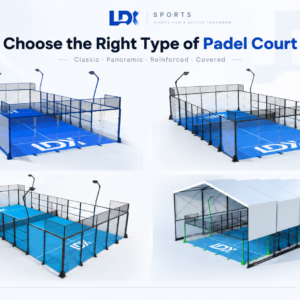
Classic Single Padel Court
A classic padel court uses a traditional combination of steel framing, mesh fencing and tempered glass.
It is a practical choice for:
- Schools
- Training centers
- Community sports facilities
- Entry-level commercial projects
- Projects with controlled budgets
For buyers who prioritize functionality, structural reliability and investment control, a classic court can provide a practical starting point.
Panoramic Single Padel Court
If appearance and spectator visibility are important, a panoramic glass padel court may be more suitable.
Panoramic designs reduce visual obstruction around important viewing areas and create a more modern commercial appearance.
This option is particularly suitable for:
- Commercial padel clubs
- Hotels and resorts
- Premium residential developments
- Fitness centers
- High-end recreational facilities
For a single-court facility, appearance can be particularly important because the court often becomes a central visual feature of the entire sports area.
Reinforced Single Padel Court
Outdoor projects in demanding environments may require stronger structural configurations or additional corrosion protection.
This may be relevant for projects exposed to:
- Strong wind
- Coastal environments
- High humidity
- Heavy rainfall
- Frequent commercial use
The final structural specification should be based on actual project conditions rather than simply selecting the heaviest possible structure.
Covered Single Padel Court
If rain, intense sunlight or unstable weather may reduce playing hours, a covered padel court should be considered during the early planning stage.
Possible systems include:
- Fixed canopy
- Independent roof structure
- Integrated roof
- Retractable canopy
- Motorized retractable roof
For a single court, weather protection can have a particularly strong operational impact. When one open court cannot be used, the entire facility becomes unavailable.
If you are unsure whether the additional roof investment is justified, compare the operating differences in our Covered vs Open Padel Court guide.
For projects requiring flexible weather protection, you can also review the electric retractable padel court roof system.
4. Do Not Choose a Single Padel Court Only by Price
Two padel courts can appear almost identical in product images but use very different materials and structural specifications.
For this reason, buyers should compare more than the final quotation.
Steel Structure
Check the steel profile dimensions, wall thickness, galvanization, welding quality, surface treatment, powder coating, structural connections and fasteners.
For outdoor single-court projects, corrosion resistance becomes particularly important.
Tempered Glass
Confirm:
- Glass thickness
- Panel dimensions
- Drilling accuracy
- Edge processing
- Connection hardware
- Export packaging
The glass system should be considered together with the supporting steel structure rather than evaluated as an isolated component.
Artificial Padel Turf
Turf directly affects traction, ball response, maintenance and the playing experience.
Important specifications include pile height, Dtex, gauge, stitch density, backing and yarn type.
Before selecting the surface, you can read our professional padel artificial turf guide to understand how different specifications affect court performance.
LED Lighting
Lighting should be planned together with the court rather than added after installation.
Confirm the fixture quantity, position, required illumination, voltage and local electrical requirements before production.
5. Where Should You Buy a Single Padel Court?
There is no single supplier location that is automatically right for every project.
A better question is:
Which supplier can provide the right combination of court manufacturing, engineering support, logistics and installation guidance for my site?
Buying From a Local Supplier
A local supplier may offer advantages such as easier site visits, familiarity with local contractors and faster communication during construction.
However, buyers should confirm whether the supplier manufactures the court directly or purchases the system from another manufacturer.
Buying Directly From an Overseas Manufacturer
Direct sourcing from an overseas padel court manufacturer can be useful when the project requires customization, factory-direct supply or a complete court package.
For international sourcing, the real value is not simply a lower equipment price.
The manufacturer should ideally be able to support:
- Project consultation
- 2D / 3D layout design
- Court configuration
- Foundation guidance
- Technical drawings
- Manufacturing
- Export packaging
- Container planning
- Shipping coordination
- Installation support
- After-sales service
You can review LDK’s complete sports facility project services to understand how design, manufacturing, installation support and after-sales service can be coordinated within one project.
6. What Should a Good Padel Court Supplier Provide?
A professional padel court supplier should provide more than a product catalog and quotation.
For a single-court project, the supplier should help connect the product with the actual construction conditions.
Project Consultation
The supplier should first understand the project location, site dimensions, application, expected user group, budget and whether the court will be installed indoors or outdoors.
Court Recommendation
The solution should then be selected according to the project.
For example:
- Classic court for a school or community facility
- Panoramic court for a hotel or commercial club
- Reinforced structure for demanding outdoor conditions
- Covered court for locations where weather limits operating hours
- Portable system where permanent foundations are unsuitable
For projects that cannot use a conventional permanent concrete foundation, it may also be worth reviewing a mobile or portable padel court solution.
Layout Design
The supplier should help determine how the court fits into the available land.
The layout may need to consider:
- Court orientation
- Player access
- Door positions
- Structural clearance
- Lighting positions
- Maintenance access
- Walkways
- Spectator areas
- Future expansion
7. How Do You Turn the Design Into a Buildable Single Padel Court Solution?
This is one of the most important differences between simply purchasing equipment and developing a real single padel court solution.
A 3D rendering may show what the finished court will look like, but it does not by itself explain how the project should be constructed locally.
If you are planning local construction, our padel court construction guide explains the main technical, commercial and installation factors that should be confirmed before work begins.
Step 1: Confirm the Site
Measure the actual usable construction area and confirm ground, climate and access conditions.
Step 2: Prepare the Court Layout
Position the court according to available space, entrances, circulation and surrounding facilities.
Step 3: Confirm the Court Configuration
Finalize the steel structure, glass, turf, lighting, doors, colors and optional roof system.
Step 4: Prepare Foundation Information
The local contractor should receive the required foundation and anchoring information before concrete work begins.
Step 5: Coordinate Drainage
Outdoor drainage should be adapted to local rainfall, ground level and discharge conditions.
Step 6: Plan Electrical Work
Confirm lighting voltage, cable routes and final electrical connections before installation.
Step 7: Begin Manufacturing
Production should begin after the major structural and technical requirements have been confirmed.
Step 8: Prepare Logistics
The shipping plan should consider container loading, glass protection, unloading equipment and access between the delivery point and construction site.
Step 9: Install the Court
The local installation team should have access to installation drawings, component identification and technical support.
Step 10: Complete Final Inspection
Before opening the court, inspect structural alignment, glass installation, turf, doors, net system, lighting and drainage.
This process turns the original purchasing requirement into a practical construction plan.
8. Foundation and Drainage Are Part of the Solution
One common mistake is treating the court equipment and civil construction as completely separate projects.
In reality, foundation quality directly affects the final court installation.
A poorly prepared foundation can lead to:
- Misaligned steel columns
- Difficult glass installation
- Door alignment problems
- Uneven turf
- Water accumulation
The manufacturer should therefore provide the relevant technical information before local foundation work begins.
For outdoor projects, drainage should also be planned according to local rainfall, site slope and civil engineering conditions.
9. Local Installation or Manufacturer-Supported Installation?
Both installation models can work successfully.
Local Installation
Local installation may be suitable when the contractor has experience working with steel structures and architectural glass and when detailed technical documentation is available.
Manufacturer-Supported Installation
Additional manufacturer support may be useful when:
- This is the buyer’s first padel project
- The court structure is highly customized
- A roof system is included
- Local contractors have limited padel court experience
Support can include installation instructions, remote guidance or optional technical supervision depending on the project.
10. A Complete Single Padel Court Solution Should Include More Than the Court
When comparing suppliers, evaluate the complete project support rather than only the steel, glass and turf package.
| Project Area | Recommended Support |
|---|---|
| Site Planning | Site evaluation and layout recommendation |
| Court Selection | Model and structural recommendation |
| Steel Structure | Manufacturing and surface treatment |
| Glass | Tempered glass and installation hardware |
| Turf | Professional padel playing surface |
| Lighting | LED system and fixture layout |
| Foundation | Technical guidance for local civil work |
| Drainage | Coordination with local contractor |
| Packaging | Export-safe packing |
| Logistics | Container and shipping planning |
| Installation | Drawings and technical support |
| After-Sales | Replacement parts and maintenance support |
This approach is especially valuable for first-time padel investors because it reduces the gap between purchasing the equipment and completing the actual facility.
11. Think About Future Expansion Before Building the First Court
Even if the project only requires one court today, ask whether another court could be added in the future.
The first site plan can consider:
- Future court position
- Shared walkways
- Drainage capacity
- Electrical capacity
- Vehicle access
- Spectator space
- Clubhouse or reception areas
This can reduce the need to redesign the entire site if demand increases later.
You can also review our sports facility application solutions for different club, hotel, community and commercial venue requirements.
12. From Single Court Design to Real Project Delivery
The strongest indicator of a supplier’s capability is not only the product rendering, but whether similar systems have been implemented in different project environments.
Different climates, site dimensions and commercial requirements often require different structural and configuration decisions.
You can view LDK’s global padel court projects to see examples of panoramic, outdoor, covered and portable padel court configurations used in different markets.
This can also help buyers understand why court design should be adapted to the site instead of using exactly the same solution for every project.
13. How LDK Supports Single Padel Court Projects
LDK provides padel court solutions for sports clubs, schools, hotels, resorts, communities and commercial sports facilities.
Available configurations include:
- Classic Padel Courts
- Panoramic Glass Padel Courts
- 360° Panoramic Padel Courts
- Reinforced Padel Courts
- Portable Padel Courts
- Covered Padel Courts
- Fixed Roof Systems
- Motorized Retractable Canopies
Depending on project requirements, a complete court system can include the steel structure, tempered glass, professional artificial turf, LED lighting, net system and related installation accessories.
For projects where civil work and installation are completed locally, the project can be coordinated from initial site information and court layout through manufacturing, shipping and installation support.
The objective is not simply to supply one court, but to help turn a proposed single padel court solution into a project that can actually be constructed at the customer’s location.
14. Single Padel Court Project Checklist
Before placing an order, confirm the following with your supplier:
- Is the available site large enough?
- Is the installation indoor or outdoor?
- Which court structure is most suitable?
- Does the climate require reinforcement?
- Is a canopy or roof required?
- What tempered glass specification is included?
- What padel turf is supplied?
- What lighting configuration is included?
- Who provides the foundation information?
- Who completes the local civil work?
- How will drainage be handled?
- Who is responsible for unloading?
- Who will install the court?
- What installation support is available?
- Are replacement parts available?
- Could the facility expand in the future?
If these questions are answered before production, the project is much easier to manage.
FAQ About Single Padel Court Solutions
What is the best single padel court for a first project?
There is no single model that fits every project. A classic court can be suitable for budget-controlled facilities, while a panoramic court is often preferred for commercial clubs, hotels and premium venues. Outdoor climate conditions may also make reinforced or covered systems more appropriate.
How much space is required for a single padel court?
The standard playing area for a doubles padel court is 20 × 10 m, but additional project space should be considered for structural elements, access and maintenance. Check the complete padel court dimensions guide before confirming the site.
Can I buy a padel court overseas and install it locally?
Yes. The manufacturer can supply the padel court system and relevant technical information while local contractors complete civil works, electrical connections and installation according to the agreed project scope.
Should I choose a classic or panoramic single padel court?
A classic court generally prioritizes functionality and investment control. A panoramic court provides greater visual openness and is often preferred for commercial or premium facilities. The decision should reflect the venue positioning and budget.
Should an outdoor single padel court have a roof?
This depends on climate, expected operating hours and project budget. If rain or intense sunlight regularly limits court availability, a covered solution may provide more consistent operation.
What should a padel court supplier provide before production?
The supplier should confirm the court configuration, dimensions, material specifications and relevant construction information. For locally installed projects, layout, foundation and installation coordination are particularly important.
Can I start with one padel court and expand later?
Yes. If future expansion is possible, the original site layout should consider the position of additional courts, drainage, electrical capacity, access and shared facility areas.
Planning a Single Padel Court Project?
A successful single padel court project requires more than choosing a court from a catalog.
The court system, site conditions, foundation, drainage, lighting, logistics and local installation should work together as one solution.
The right supplier should help answer three important questions:
Which padel court is suitable for my site?
How should the court be configured for my environment and application?
How can the design be converted into a practical local construction plan?
If you are planning a single padel court, send us your project location, available site dimensions, indoor or outdoor application and preferred court type.
LDK can help with court configuration, layout planning, technical coordination, manufacturing, shipping and installation support.