Are you planning to build a padel court locally but not sure how to choose a cost-effective court system and manage the construction process?
If you are preparing to purchase a padel court, this guide will help you understand what to consider before making a decision.
This guide explains the most important technical, commercial and installation factors to consider before starting a padel court construction project.
1. Start With Your Padel Court Construction Site
Before choosing a court model or requesting a quotation, the first step is to understand the actual construction site.
A padel court is not simply a steel and glass structure that can be installed anywhere. Site dimensions, ground conditions, drainage, surrounding buildings, access and local climate can all affect the final court configuration.
Before contacting a padel court builder or manufacturer, it is useful to prepare the following project information:
- Project country and city
- Indoor or outdoor installation
- Available construction area
- Number of padel courts required
- Existing ground or concrete condition
- Drainage conditions
- Local wind and rainfall conditions
- Distance from the sea or other corrosive environments
- Access for trucks, forklifts and lifting equipment
For multi-court clubs, you should also consider walkways, spectator areas, reception areas, seating, landscaping and maintenance access.
Good site planning at the beginning can prevent major changes during installation.
2. Choose the Right Type of Padel Court
The most cost-effective padel court is not necessarily the cheapest model. It is the court that matches the application, local environment, expected usage and project budget.
Different padel court construction projects may require different structures.
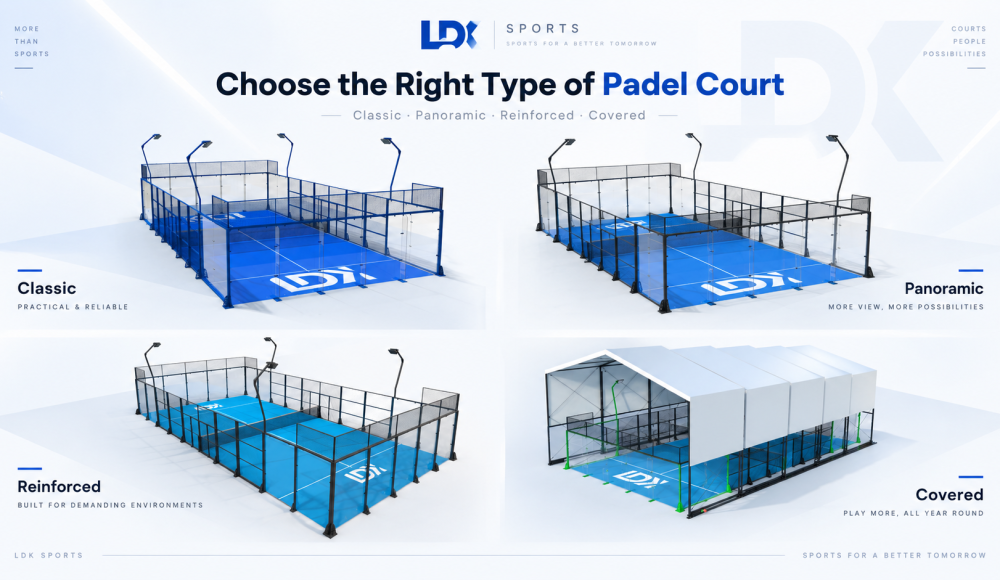
Classic Padel Court
A classic padel court uses a traditional steel frame and glass enclosure. It is a practical option for schools, training centers, sports clubs and community facilities where durability and budget control are important.
Panoramic Padel Court
A panoramic padel court provides larger glass viewing areas and fewer visual obstructions around key sections of the court.
This design is often selected for commercial padel clubs, resorts, premium sports centers and competition venues where appearance and spectator visibility are important.
Reinforced Padel Court
Outdoor projects in demanding environments may require reinforced columns, stronger structural connections or additional corrosion protection.
Rather than choosing a reinforced court only because it appears stronger, the structure should be selected according to the actual site conditions and local engineering requirements.
Covered Padel Court
If rain, strong sunlight or changing weather could reduce playing hours, a covered court may provide a better long-term operating solution.
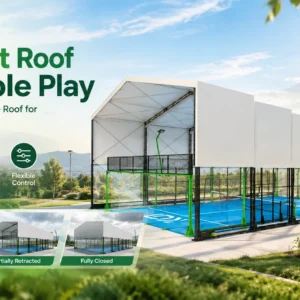
Common options include fixed canopies, independent roof structures, integrated roofs and motorized retractable canopies.
If a roof may be required, it is better to include it during the original construction planning rather than trying to add it after the court has already been installed.
3. Define What the Manufacturer Supplies and What Is Built Locally
This is one of the most important parts of an international padel court project.
In many projects, the manufacturer supplies the complete padel court system while local contractors complete the civil construction and utilities.
| Project Item | Padel Court Manufacturer | Local Contractor |
|---|---|---|
| Court structural design | Yes | – |
| Steel structure | Yes | – |
| Tempered glass | Yes | – |
| Artificial padel turf | Yes | – |
| LED lighting | Yes | – |
| Fasteners and accessories | Yes | – |
| Foundation drawings | Usually provided | – |
| Concrete foundation | – | Yes |
| Drainage construction | – | Yes |
| Electrical connection | – | Yes |
| Court installation | Optional support | Local or manufacturer team |
The exact scope can vary from project to project.
Before placing an order, both parties should clearly confirm who is responsible for the foundation, drainage, unloading, lifting equipment, installation, electrical connection and final site work.
This avoids additional costs and installation delays later.
4. Pay Special Attention to the Foundation
A high-quality court structure still requires a properly prepared foundation.
The base affects structural alignment, glass installation, turf flatness, door operation and long-term court stability.
Before local contractors begin concrete work, they should receive the approved foundation or layout drawings from the court manufacturer.
These drawings should clearly indicate the court dimensions, structural positions, anchor locations and relevant construction reference points.
If the foundation is uneven or incorrectly positioned, installers may have difficulty aligning steel columns and tempered glass panels.
For this reason, the foundation should be checked before the court equipment arrives at the site.
5. Plan Outdoor Drainage Before Installation
Drainage is especially important for outdoor padel court construction.
Water remaining around or inside the court can affect turf performance, surrounding civil work and long-term maintenance.
The local contractor should evaluate rainfall, site slope, existing drainage systems and the direction in which water can safely discharge.
The padel court manufacturer can provide structural and layout information, while the local civil contractor should adapt the drainage solution to local ground conditions and construction regulations.
Using this combined approach is generally more practical than applying exactly the same drainage solution to every country or project.
6. Check the Steel Structure Specification
When comparing quotations from different padel court builders, do not compare only the appearance of the finished court.
The steel structure has a major influence on stability, durability and long-term maintenance.
Important points to check include steel profile dimensions, wall thickness, galvanization, welding quality, surface treatment, powder coating, structural connections and fasteners.
Corrosion protection becomes particularly important for outdoor courts located in humid, high-rainfall or coastal environments.
A lower initial purchase price may not result in lower lifetime cost if the steel structure requires frequent repair or repainting.
7. Confirm the Tempered Glass Specification
Glass is both part of the playing enclosure and an important structural component of a padel court.
Before purchasing, confirm the glass thickness, dimensions, drilling accuracy, edge processing, connection hardware and packaging method.
For many LDK padel court configurations, 12 mm tempered glass can be supplied according to the project design.
For international projects, packaging should also be considered carefully.
Glass panels must pass through factory handling, container loading, ocean or land transportation, port handling and final delivery to the construction site.
Professional packaging helps reduce transportation risks and makes unloading and installation easier.
8. Select the Right Artificial Padel Turf
Artificial turf should not be selected only by color.
It directly affects ball response, player movement, traction, comfort and maintenance.
When comparing complete padel court packages, check specifications such as pile height, yarn type, Dtex, gauge, stitch density and backing system.
For example, professional padel turf configurations may use a 12 mm pile height with specifications selected according to playing requirements and project usage.
A commercial club with high daily usage may place greater emphasis on durability and maintenance, while competition or professional training facilities may focus more heavily on consistent playing performance.
9. Include the Lighting System in the Original Design
Lighting should be planned before the court structure is manufactured.
The number and position of LED fixtures affect both the structural design and local electrical work.
Before production, confirm whether the project is indoor or outdoor, the required illumination level, fixture quantity, voltage, cable routing and local electrical requirements.
For commercial clubs that operate in the evening, lighting quality also affects customer experience and available operating hours.
For this reason, the lighting system should be treated as part of the complete padel court installation, rather than as an accessory added at the end.
10. Request Installation Drawings Before Shipping
If the padel court will be assembled by a local contractor, clear installation documentation becomes particularly important.
The manufacturer should provide relevant information for the main installation stages, including foundation preparation, structural assembly, glass installation, turf installation and lighting positions.
Court components should also be clearly identified and organized before shipment where possible.
This can make the installation process easier for contractors who have not previously assembled the same court system.
Remote technical guidance, installation videos or on-site technical support may also be useful for larger or more complicated projects.
11. Prepare Local Labor and Installation Equipment
Before the containers arrive, confirm how the court will be unloaded and installed.
The required resources may include installers, general labor, forklifts, glass lifting equipment, working platforms, measuring tools and electrical equipment.
Tempered glass requires particularly careful handling.
Using an installation team with experience in steel structures and architectural glass can reduce the risk of damage, alignment problems and unnecessary delays.
The cost of these local resources should be included when calculating the complete project budget.
12. Calculate the Complete Padel Court Construction Cost
The court purchase price is only one part of the total investment.
A realistic padel court construction cost should consider the equipment, civil construction, transportation and local installation together.
| Cost Category | Main Cost Factors |
|---|---|
| Padel court system | Steel, glass, turf, lighting and accessories |
| Foundation | Concrete, ground preparation and local labor |
| Drainage | Drainage channels and site work |
| Shipping | Container freight and inland transportation |
| Import costs | Local duties, taxes and handling where applicable |
| Installation | Local labor or technical supervision |
| Equipment | Forklift, crane or glass handling equipment |
| Electrical work | Cabling and power connection |
| Canopy or roof | Fixed or retractable roof system if required |
This is why it can be misleading to compare different suppliers only by the EXW or FOB price of the court.
A more useful question is:
What will the total cost be to complete the padel court at my project location?
This provides a better basis for comparing different construction solutions.
13. Consider Future Maintenance Before Purchasing
A good court should also be easy to maintain after installation.
Before purchasing, ask about the availability of replacement glass, lighting components, turf, doors, hardware and structural accessories.
This is particularly important for commercial padel clubs because extended court downtime can directly affect revenue.
Regular inspections of the steel connections, glass fittings, turf, lighting, doors and drainage system can help identify small problems before they become more expensive repairs.
For multi-court facilities, keeping basic replacement parts on site may also reduce maintenance downtime.
14. Check Local Building Requirements
Construction requirements vary by country and municipality.
Depending on the project, local authorities may have requirements related to structural calculations, wind loads, electrical systems, noise, accessibility, permits or roof structures.
The padel court manufacturer should provide available technical information about the court system, but final construction approval normally depends on local regulations.
This is especially important for large commercial facilities and covered padel courts.
Consulting a local architect, engineer or contractor before production can prevent expensive design changes later.
15. Choose a Padel Court Manufacturer That Can Support the Project
Price is important, but international padel court construction requires more than manufacturing the steel frame and loading it into a container.
A professional supplier should be able to support the project from court selection through installation.
Useful support may include court configuration, layout planning, technical drawings, foundation guidance, customized structural solutions, shipping coordination, installation documentation and after-sales service.
For projects that will be built locally, communication between the manufacturer and the local contractor is especially important.
Solving technical questions before construction is usually much easier and less expensive than solving them during installation.
How LDK Supports Padel Court Construction Projects
LDK provides padel court systems for sports clubs, schools, resorts, commercial facilities and multi-court developments.
Available solutions include classic padel courts, panoramic padel courts, 360° panoramic courts, reinforced structures, portable padel courts, covered courts and fixed or motorized retractable canopy systems.
Depending on the project requirements, the court system can include galvanized steel structures, tempered glass, professional artificial padel turf, LED lighting and related installation accessories.
For international projects where civil work and installation are completed locally, technical drawings and construction guidance can be coordinated before shipment.
This allows the local contractor to prepare the site while the padel court system is being manufactured.
Typical Padel Court Construction Process
A project that combines international equipment purchasing with local construction can generally be divided into the following stages:
- Project Consultation: Confirm the project location, quantity, application and basic requirements.
- Site Evaluation: Review dimensions, ground conditions and local climate.
- Court Selection: Choose the appropriate classic, panoramic, reinforced, portable or covered court.
- Layout and Technical Design: Confirm court positioning and construction drawings.
- Foundation Construction: The local contractor completes the required civil work.
- Court Manufacturing: Steel, glass, turf, lighting and accessories are prepared.
- Shipping and Site Preparation: Court equipment is transported while installation resources are prepared locally.
- Padel Court Installation: The steel structure, glass, turf and lighting system are assembled.
- Final Inspection: Structural alignment, playing surface, lighting and other details are checked before use.
Good coordination between these stages can reduce delays and make the overall construction process more predictable.
Complete Padel Court System vs Buying Components Separately
Some buyers consider purchasing steel, glass, turf and lighting separately in order to reduce the initial cost.
However, the components of a padel court need to work together as one system.
| Complete Padel Court System | Separate Components |
|---|---|
| Unified structural design | Different specifications must be coordinated |
| Compatible dimensions | Compatibility must be checked locally |
| One technical contact | Multiple suppliers |
| Clear installation sequence | More site coordination required |
| Standardized hardware | Components may use different systems |
| Easier after-sales support | Responsibility may be unclear |
For commercial projects, purchasing a coordinated court system can make installation and future maintenance easier.
Common Mistakes When Building a Padel Court Locally
Many construction problems can be avoided before the equipment even leaves the factory.
Starting the Foundation Without Approved Drawings
If anchor points, dimensions or elevations do not match the final court structure, additional civil work may be required.
Choosing a Court Only by Price
Steel thickness, surface treatment, glass, turf, lighting and accessories can vary significantly between different court systems.
Ignoring Outdoor Drainage
Poor drainage can affect the playing surface and create additional long-term maintenance.
Not Preparing Installation Equipment
Glass handling equipment, working platforms and suitable tools should be available when the court arrives.
Planning Electrical Work Too Late
LED lighting positions, cables and electrical connections should be considered before installation.
Not Defining Responsibilities
The manufacturer and local contractor should clearly understand which parts of the project each party is responsible for.
FAQ About Padel Court Construction
Can I purchase a padel court from China and have it installed locally?
Yes. Many international projects use this model. The manufacturer supplies the padel court system and technical documentation, while local contractors complete the foundation, drainage, electrical work and installation according to the agreed project scope.
What should be completed before the padel court arrives?
The foundation and relevant civil work should normally be completed and inspected. Access, installation labor, unloading equipment, glass handling equipment and utilities should also be prepared.
What is the difference between a classic and panoramic padel court?
Classic courts use a more traditional steel-frame configuration, while panoramic courts reduce visual obstructions around important viewing areas. Panoramic courts are commonly selected for commercial clubs, tournaments and premium facilities.
How much does padel court construction cost?
The total cost depends on the court model, steel structure, glass, turf, lighting, foundation, shipping, installation, local labor and whether a canopy or roof is required. Buyers should compare the complete installed project cost rather than only the factory price of the court.
Do outdoor padel courts need drainage?
Drainage should be considered for outdoor installations. The exact drainage solution depends on rainfall, ground conditions, site slope and local civil engineering requirements.
Can a roof or canopy be added to a padel court?
Yes. Fixed, independent and retractable canopy systems are available for different projects. However, it is better to plan the roof during the initial design stage so the structure, foundation and drainage can be coordinated correctly.
What information should I provide when requesting a quotation?
Provide the project country, number of courts, indoor or outdoor application, available dimensions, preferred court type, roof requirements and expected installation method. Site drawings or photos can also help the manufacturer recommend a more suitable solution.
Planning a Padel Court Construction Project?
A successful padel court starts with the right planning.
Site conditions, foundation, drainage, structural design, glass, turf, lighting, shipping and local installation should be coordinated before production begins.
For developers, sports clubs and commercial operators purchasing internationally, combining a professional padel court system with reliable local construction resources can provide a practical and cost-effective project solution.
Planning to build a padel court? Send LDK your project location, court quantity, available site dimensions and preferred court type.
Our team can provide court configuration recommendations, layout support, foundation guidance, shipping solutions and installation assistance for your padel court construction project.