Choosing between panoramic and standard padel courts is an important investment decision for sports facility developers, commercial club owners, and municipal project managers. Both designs provide the same standard playing area of 10 × 20 meters, but their structural layouts, spectator visibility, installation requirements, and commercial potential differ.
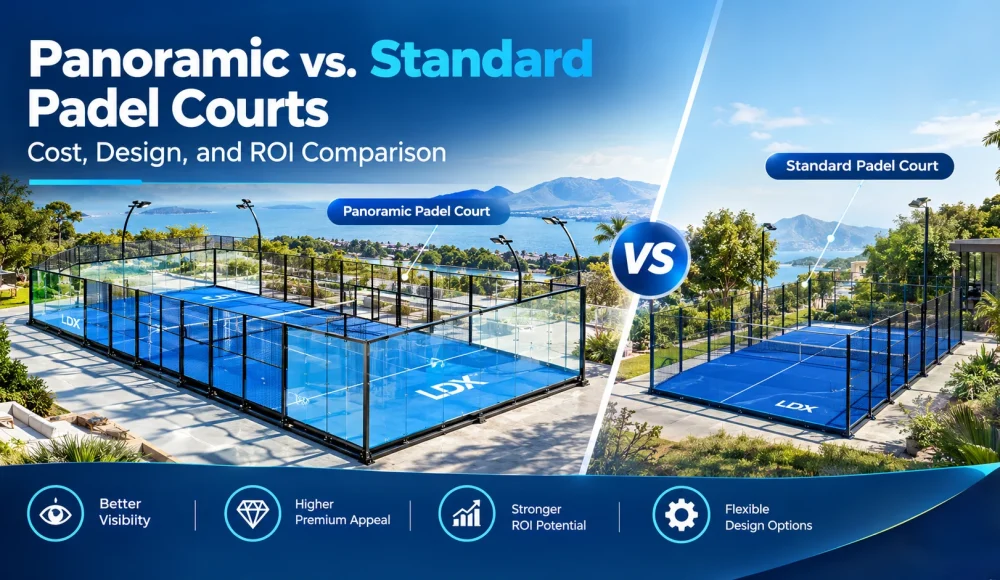
A panoramic padel court uses an optimized structural framework and larger glass panels to improve visibility for spectators, photographers, and broadcast cameras. A standard padel court typically incorporates more visible structural posts and mesh sections, making it a practical option for recreational facilities and budget-conscious projects.
However, improved visibility does not automatically translate into higher profits. The right choice depends on the facility’s target users, revenue model, construction budget, and long-term operating strategy.
This guide compares panoramic vs. standard padel courts to help B2B buyers evaluate construction costs, structural requirements, commercial value, and project suitability before purchasing.
1. Panoramic vs. Standard Padel Courts: Key Differences
Both court types support the same basic playing dimensions and core padel experience. Their primary differences lie in the surrounding structure, visual openness, and intended facility positioning.
| Comparison Factor | Standard Padel Court | Panoramic Padel Court |
|---|---|---|
| Playing Dimensions | Standard 10 × 20 m | Standard 10 × 20 m |
| Structural Design | More visible posts and mesh-supported sections | Reduced visual obstruction through an optimized support framework |
| Spectator Visibility | Some sightlines may be interrupted by posts and mesh | Wider, clearer viewing angles through larger glass panels |
| Glass Configuration | Glass panels integrated with a more segmented frame | Larger glass panels with carefully engineered support connections |
| Visual Presentation | Functional, conventional court appearance | Contemporary, premium presentation |
| Typical Applications | Community centers, schools, residential developments, recreational clubs | Premium sports clubs, tournament venues, hospitality projects |
| Initial Investment | Generally lower | Generally higher |
| Installation Considerations | Conventional structural assembly and glass installation | Requires careful coordination of glass handling, structural connections, and installation tolerances |
| Commercial Opportunities | Court rentals, memberships, coaching, and recreational programs | The same revenue streams, with additional potential for spectator events and broadcast-friendly facilities |
Note: Actual specifications, pricing, and structural configurations vary by manufacturer, site conditions, glass design, and project requirements.
For buyers comparing suppliers, the most important distinction is not simply the amount of glass used. It is how the entire court structure balances playing performance, visibility, safety, installation efficiency, and lifecycle cost.
2. What Is a Panoramic Padel Court?
A panoramic padel court is designed to improve visibility by reducing the visual obstruction created by conventional structural posts and mesh sections.
Instead of relying on a more segmented frame layout, panoramic designs use larger glass panels and an engineered support system to create a more open appearance.
Key Features of Panoramic Padel Courts
Enhanced spectator visibility: Larger glass panels create clearer viewing areas for spectators and make it easier to follow rallies from outside the court.
Broadcast-friendly design: Reduced visual obstruction can help camera operators capture cleaner footage for tournaments, livestreams, and promotional content.
Premium visual appeal: The open glass structure creates a contemporary appearance that complements high-end sports clubs, hotels, and commercial leisure facilities.
Flexible commercial positioning: Operators can incorporate panoramic courts into premium membership packages, branded events, and tournament-oriented facility concepts.
However, panoramic construction does not guarantee completely unobstructed 360-degree visibility. Structural beams, glass joints, access doors, and other components may still affect particular viewing angles.
When evaluating a design, buyers should review the manufacturer’s structural drawings and completed installation references rather than rely on marketing descriptions alone.
3. How Much More Does a Panoramic Padel Court Cost?
A panoramic padel court generally requires a higher initial investment than a comparable standard court. The actual price difference depends on the structural design, glass specifications, manufacturing process, transportation distance, and installation conditions.
Rather than applying a universal cost premium, buyers should request itemized quotations based on equivalent project specifications.
Main Cost Differences
1. Glass materials and processing
Panoramic courts use larger glass panels that may require specialized handling, processing, packaging, and lifting equipment. Glass thickness and specifications depend on the approved design and applicable requirements.
2. Structural framework
Reducing visible support posts changes how the remaining frame distributes loads. Manufacturers must engineer the structural connections and supporting components to suit the selected glass configuration and installation environment.
3. Transportation and packaging
Large glass panels require careful protective packaging and handling. Buyers should compare shipping volume, packaging methods, unloading requirements, and the risk of transit damage.
4. Installation requirements
Panoramic designs may require more precise alignment and coordinated installation of glass panels and structural connections. Site access, foundation preparation, available lifting equipment, and local labor rates can influence installation costs.
How to Compare Total Project Costs
| Cost Component | Standard Court | Panoramic Court |
|---|---|---|
| Court structure | Standard frame configuration | Design-specific engineered framework |
| Glass panels | Segmented glass layout | Larger panels in selected areas |
| Packaging and freight | Depends on shipment size and weight | May require additional glass protection and handling |
| Installation | Depends on site and assembly requirements | May require more precise glass alignment and lifting arrangements |
| Maintenance | Depends on materials, usage, and environment | Depends on glass, frame, connections, and exposure |
| Total investment | Establish a project-specific baseline | Compare against an equivalent panoramic specification |
For procurement purposes, compare the complete delivered and installed cost wherever possible. A low factory price may not represent the lowest total project cost once freight, installation, foundation work, and maintenance are included.
4. Is the Spectator Experience Premium Worth Paying For?
The additional investment in a panoramic padel court makes the most sense when improved visibility supports the facility’s commercial objectives.
For a community sports center, the primary goal may be to provide affordable access to recreational activities. For a premium club, the same court may serve as a visual centerpiece that supports events, member engagement, and brand positioning.
When a Panoramic Court May Deliver More Value
Premium commercial clubs
Panoramic courts can strengthen a club’s visual identity and provide an attractive setting for member events, competitions, and social activities.
Tournament and broadcast venues
Clearer viewing angles can improve the spectator experience and simplify camera positioning. These features may be particularly valuable when the venue regularly hosts competitive events.
Luxury hotels and resorts
A panoramic court can complement premium leisure facilities and create a visually appealing amenity for guests and private members.
Sports facilities with sponsorship ambitions
A tournament-oriented venue may attract sponsorship opportunities through event programming, advertising placements, and digital content. However, actual sponsorship revenue depends on audience reach, event quality, and commercial partnerships.
When a Standard Court May Be the Better Investment
Standard courts are often suitable for schools, municipal facilities, residential communities, and recreational clubs where affordability and utilization are the primary considerations.
If most revenue comes from ordinary hourly rentals, coaching, and memberships, the additional visual benefits of panoramic construction may not justify the higher initial cost.
The key is to evaluate the incremental revenue and operating benefits that the panoramic design could realistically generate.
5. Structural Safety: Glass Specifications and Wind-Load Engineering
Safety is a critical consideration when selecting any padel court, particularly a panoramic design with larger glass panels and fewer visible support posts.
The court must withstand the loads associated with ball impacts, normal operation, environmental exposure, and the installation conditions specified by the structural design.
Glass Thickness and Safety Requirements
Padel court manufacturers commonly offer tempered safety glass in different thicknesses, including 10 mm and 12 mm configurations. However, buyers should not assume that one thickness is universally appropriate for every court.
The required glass specification depends on panel dimensions, support conditions, impact requirements, applicable regulations, and the manufacturer’s validated design.
For European projects, buyers may request documentation demonstrating compliance with applicable glass product requirements, including EN 12150-1 where relevant. In China, GB 15763.2 may apply to the relevant tempered glass product.
These standards address glass product requirements; they do not independently establish that an entire padel court structure is safe.
Before approving a quotation, request confirmation of the glass type, thickness, edge finishing, drilling and processing requirements, and supporting test documentation.
Structural Framework and Wind Loads
Outdoor panoramic courts require particular attention to wind exposure. Larger glass panels can change the loads transferred to the frame, connections, and foundations.
A suitable engineering review should consider:
- Local wind conditions and exposure category.
- Glass panel dimensions and support arrangements.
- Steel frame profiles and connection details.
- Anchor specifications and foundation design.
- Drainage, corrosion protection, and environmental exposure.
- Installation tolerances and inspection requirements.
Removing visible corner posts does not necessarily mean that the glass panels are completely unsupported. The actual load-bearing arrangement depends on the manufacturer’s design.
For outdoor projects, buyers should request structural documentation appropriate to the installation site and applicable local requirements.
6. How to Choose Between Panoramic and Standard Padel Courts
A structured procurement process helps developers select the right court configuration without paying for features that provide limited value to their facility.
Step 1: Define the Facility’s Primary Purpose
Determine whether the project focuses on recreational participation, membership growth, premium sports experiences, or competitive events.
A community facility may prioritize durability and affordable access. A tournament venue may place greater emphasis on spectator visibility and broadcast requirements.
Step 2: Evaluate the Revenue Model
Identify how the court will generate income. Consider hourly rentals, memberships, coaching, tournaments, sponsorships, and other services that the facility can realistically offer.
Do not assume that panoramic courts automatically support higher rental prices. Validate the premium through local market research and customer demand.
Step 3: Compare Technical Specifications
Request comparable quotations for both court types. Confirm glass specifications, frame materials, coatings, structural calculations, accessories, and installation requirements.
This helps ensure that the price comparison reflects equivalent quality and project scope.
Step 4: Assess Site and Logistics Requirements
Review foundation conditions, installation access, freight costs, unloading equipment, local labor, and any applicable permits.
For multi-court projects, also evaluate the supplier’s production capacity, delivery schedule, and ability to maintain consistent specifications across all courts.
Step 5: Calculate Total Cost of Ownership
Compare the initial investment with expected maintenance, repair requirements, utilization, and potential revenue over the planned operating period.
The best choice is the court that meets the project’s technical requirements and business objectives at an acceptable total cost.
7. B2B Procurement FAQs
Q1: What is the main difference between a panoramic and a standard padel court?
The primary difference is the structural layout and viewing experience. Panoramic courts use larger glass panels and an optimized support arrangement to reduce visual obstruction. Standard courts typically feature more visible structural posts and mesh sections.
Q2: Are panoramic padel courts more expensive?
They generally require a higher initial investment because of glass configuration, structural engineering, handling, and installation considerations. The actual premium depends on the supplier’s design and the project scope.
Q3: Do panoramic padel courts generate more revenue?
They may create additional commercial opportunities when the venue attracts premium bookings, spectators, tournaments, or sponsors. However, higher revenue is not guaranteed and depends on local demand and facility management.
Q4: What glass thickness is suitable for a panoramic padel court?
Glass thickness must match the panel dimensions, support arrangement, impact requirements, and applicable standards. Buyers should obtain the manufacturer’s approved specifications and relevant test documentation rather than select thickness based on a general recommendation.
Q5: Can panoramic padel courts be installed outdoors?
Yes, provided the design is suitable for outdoor use and accounts for wind loads, foundations, corrosion protection, drainage, and local environmental conditions. Buyers should confirm these requirements before ordering.
Q6: What should buyers include in a padel court quotation request?
A useful inquiry should specify the court type, quantity, indoor or outdoor installation, project location, glass requirements, lighting and accessory needs, foundation scope, delivery terms, and installation requirements.
Q7: Can a padel court manufacturer provide customized solutions?
Depending on the manufacturer’s capabilities, customization may cover structural finishes, court colors, lighting, branding, accessories, and project-specific configurations. Buyers should confirm available options and technical limitations before finalizing specifications.
Conclusion: Select the Right Padel Court for Your Business Model
Choosing between panoramic and standard padel courts requires more than comparing appearance and purchase price. Developers must evaluate spectator visibility, structural engineering, installation requirements, and the commercial objectives of the facility.
Standard padel courts are often a practical choice for community sports, schools, and recreational facilities where budget and utilization take priority.
Panoramic padel courts may offer greater strategic value for premium clubs, tournament venues, and projects where spectator experience and visual presentation are important.
For B2B buyers, the most effective procurement strategy combines a clear facility plan, comparable supplier quotations, validated engineering specifications, and a realistic return-on-investment assessment.
Request a Custom Padel Court Quote
Planning a new padel facility or upgrading an existing sports venue?
Contact our team to discuss panoramic and standard padel court options, structural specifications, glass configurations, customization, and bulk project requirements. Share your project location, intended application, court quantity, and preferred configuration to receive a tailored quotation.
Request a quote to find the right padel court solution for your facility.